The Printing Apparatus
1849 · Stereotype Printer · Work 487 of 1,871
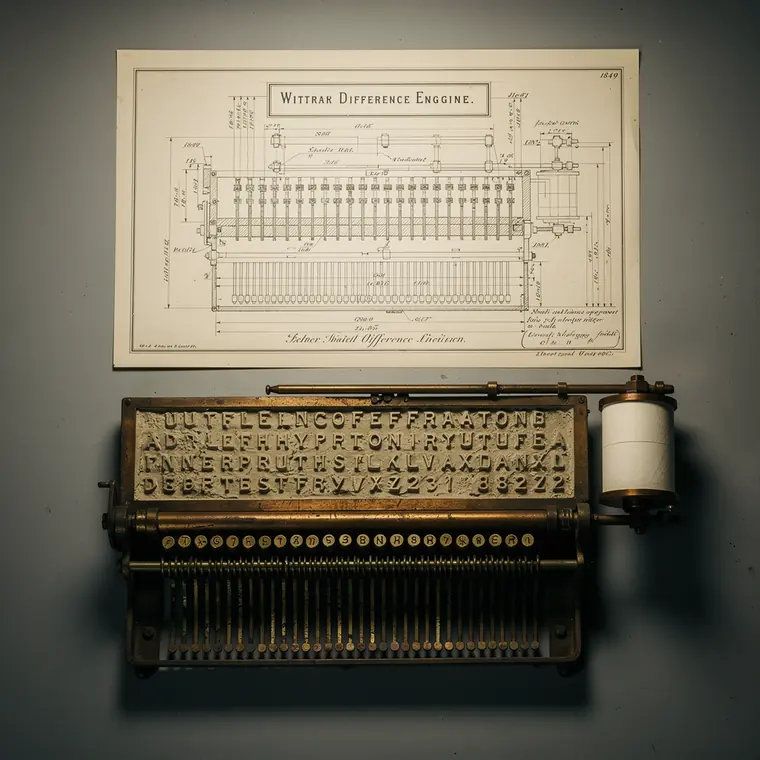
An engineering drawing of the printing apparatus of a difference engine, ink on cream paper, plan and elevation, the bed of movable type heads shown in section above a tray for soft plaster, a paper roll on a spindle alongside for a second copy, levers for setting the column layout, ruled dimension lines, the title block a plain ruled box, the drawing laid flat on a grey studio table, even flat light from directly above.
- What it was used for
- The printing and stereotyping apparatus was the output end of Difference Engine No. 2. Between calculation and printing plate no hand was to remain: transcription and typesetting were where printed tables acquired their errors. The apparatus typesets each result automatically, prints an inked copy on a paper roll, and at the same time impresses the same figures into soft material held in trays, from which stereotype plates can be cast; the Science Museum names plaster of Paris as the material it tested. Of the 31 digits of the result column, 30 are transferred; the highest is not printed. Line height, lines per page (30, 50 or 60), number of columns, margin widths and blank lines between groups are set on pattern wheels.
- What was new
- Compared with transcription and hand typesetting, what was new was the coupling: the machine typesets, prints and stereotypes in the same cycle in which it calculates, with no buffering and no extra time, and the page format is configurable. Babbage designed the engine between 1846 and 1849; the main drawings are dated 1847 to 1849 (Swade's 2005 paper gives the design period as 1846 to 1848). None of it was built in his lifetime. The Science Museum completed the calculating section in 1991 and the output apparatus only in March 2002: 4,000 parts, half of a machine weighing five tonnes. That the design holds was therefore demonstrated 153 years after the drawings.