The Barrel
1837 · Control Drum · Work 491 of 1,871
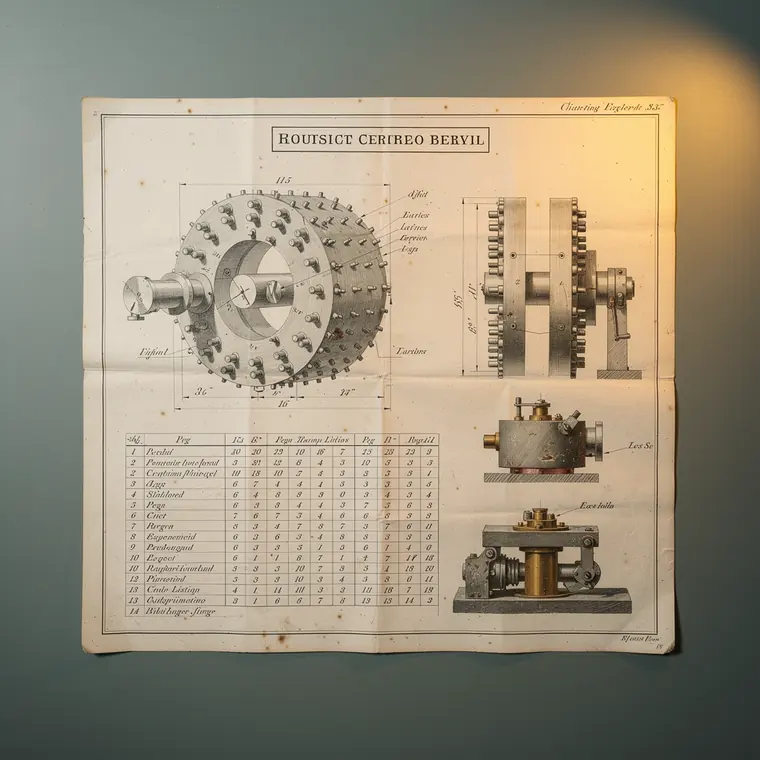
An engineering drawing of a control barrel, ink on cream paper, a studded rotating drum drawn in section and in elevation, pegs set into its surface in irregular patterns, each peg shown lifting a lever as the drum turns, a table of ruled columns beside the drawing, ruled dimension lines, the title block a plain ruled box, the sheet laid flat on a grey studio table, even flat light from directly above.
- What it was used for
- The barrels controlled the internal sequences. Studs were screwed to a barrel; as the barrel moved sideways, a vertical row of studs acted on the ends of the control levers. Bromley calls the barrel a microprogram store and a single vertical row of studs a word of that store. For a signed addition three barrels worked together; in practice a barrel might act on 50, 100 or more control levers and have 50 to 100 verticals. A reducing apparatus of sectors advanced the barrel by the ordered number of verticals, and several sectors could act in combination.
- What was new
- In the earliest designs a barrel of this kind stood where the punched cards later went, and Bromley writes that cards were substituted to overcome its evident inflexibility. The internal barrels remained: the exchangeable program outside, the fixed sequence inside. According to Bromley, though, a hierarchy of levels of control was already strikingly evident in the earliest designs, when a barrel still sat at the top. That he describes the barrel in 1982 with the word microprogram is his classification, not Babbage's.