The Anticipating Carriage
1838 · Carry Mechanism · Work 492 of 1,871
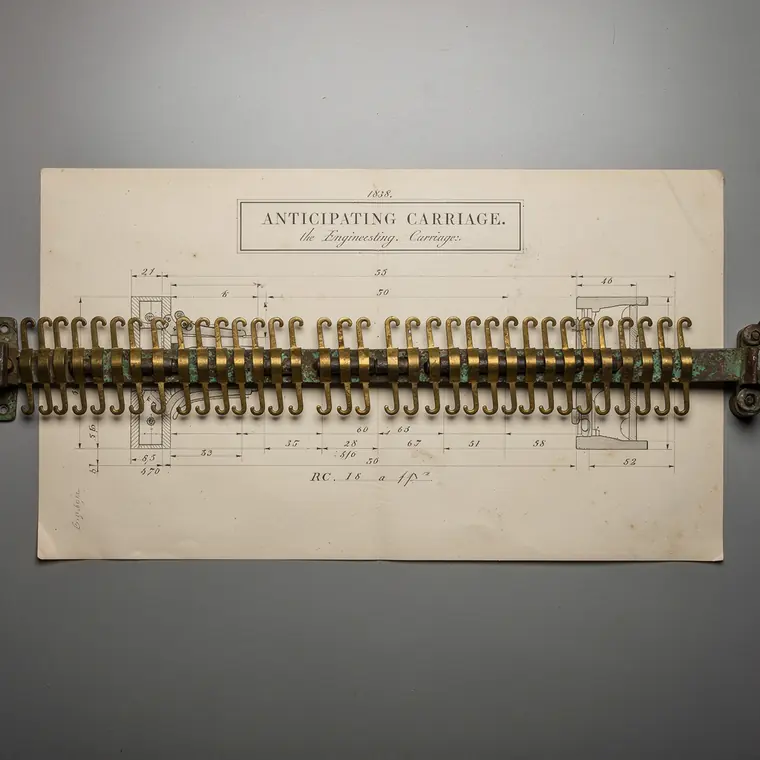
A detail drawing of the anticipating carriage, an engineering drawing in ink on cream paper, a comb of hooked levers set along a rocking bar, the hooks repeating in a long row across fifty digit positions, small arrows showing the sweep of the bar resolving every carry in one motion, the levers drawn in elevation with a section through the bar beside them, ruled dimension lines, the title block a plain ruled box, the sheet laid flat on a grey studio table, even flat light from directly above.
- What it was used for
- In adding long numbers, the carry is the time problem. If it propagates digit by digit, the complete chain of carry propagation could, Bromley writes, in the worst case take five times as long as the digitwise parallel addition itself. Babbage's anticipating carriage determined in advance where a carry would run: at every digit whose figure wheel stands at 9, a movable wire completes a chain with the fixed wires - Bromley describes this as a logical AND. A carry can thus propagate through any number of cages without requiring any additional time.
- What was new
- What was new can be read off the price. Babbage calculated that for a carry from the units to the 40th cage the wires and carry sectors together came to around 50 pounds, some 23 kilograms - and that mass had to be lifted through 0.65 inch in 0.15 seconds. The device that saved time thus created a problem of mass, and it was so complex that, in Bromley's account, it was the initial incentive to separate store and mill so as to concentrate the arithmetic in one place.