The Trial Model
1871 · Part-Assembled Mill · Work 494 of 1,871
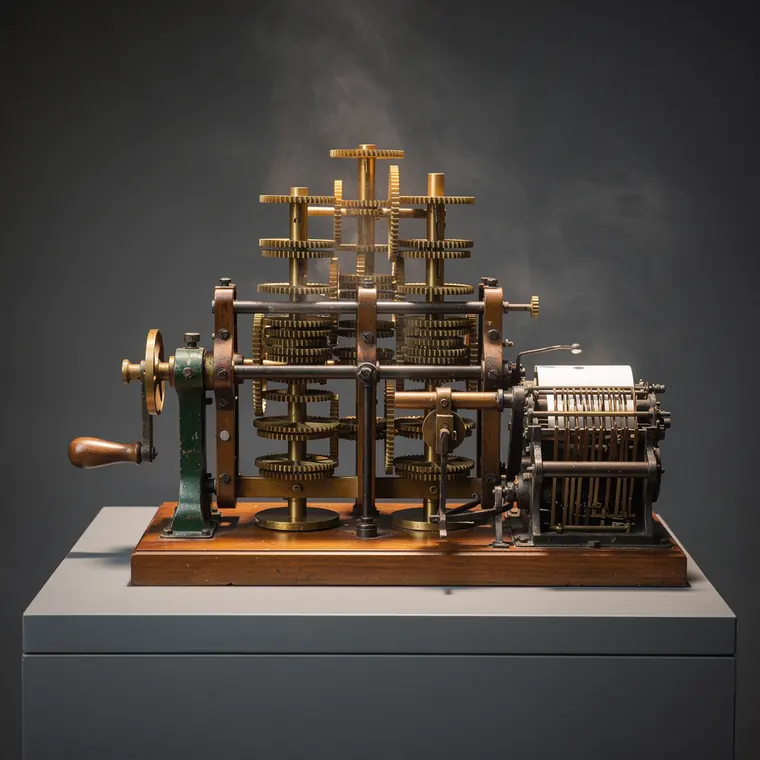
A small assembled portion of the mill of the Analytical Engine on a wooden base, a handful of brass gear columns each a stack of toothed wheels one above the other, a crank at the side, steel shafts in bronze frames, a small printing mechanism beside the columns, the metal warm against the grey, the model standing on a plain grey plinth before a flat grey background, even flat light from directly in front.
- What it was used for
- The piece in the Science Museum (inventory number 1878-3) is, according to the catalogue record, a portion of the mill of the Analytical Engine with printing mechanism, designed by Charles Babbage and under construction at the time of his death. It measures 1000 by 1250 by 600 millimetres and is made of steel, brass, bronze, further metal and wood; the design goes back to 1834. It was a trial piece: it was to show whether the sub-assemblies that had existed since 1834 only as drawings and notations would work mechanically. It never computed a table for any customer.
- What was new
- After his father's death in October 1871, Henry Prevost Babbage inherited the calculating machines together with the tools, models and drawings. On 21 January 1888 a mill he had assembled produced a table of the 1st to 44th multiples of pi to 29 places, published in the Monthly Notices of the Royal Astronomical Society in April 1910. It was not this trial piece: according to Henry, the frame plates of his machine were cast only in 1880; his mill is a separate object in the Science Museum (1896-58). The Whipple volume speaks of Henry's long and obsessive campaign of filial piety and likens his systematic distribution of mementos to the actions of traditional impresarios of saintly relics.
Connections
Every connection names its kind. “Forerunner” on its own would be a claim.
- Follows fromThe Mill1837The Science Museum catalogues the trial piece as a "Portion of the mill of the Analytical Engine with printing mechanism", designed by Babbage and still under construction at his death in 1871. Only part of the machine was completed as a trial piece before he died.Source: Science Museum Group: Babbage's Analytical Engine, 1834-1871 (Trial model), Objekt co62245
Further reading
- Science Museum Group Collection: Babbage's Analytical Engine, 1834-1871 (Trial model), inv. 1878-3
- Computer History Museum: January 21 - Babbage's Analytical Engine Passes the First Test
- Ideas Embodied in Metal: Babbage's Engines Dismembered and Remembered, in: The Whipple Museum of the History of Science (Cambridge University Press)
- Science Museum Group Collection: Henry Babbage's Analytical Engine Mill, 1910, inv. 1896-58