The Second Scheutz Machine
1859 · Scheutz Machine · Work 497 of 1,871
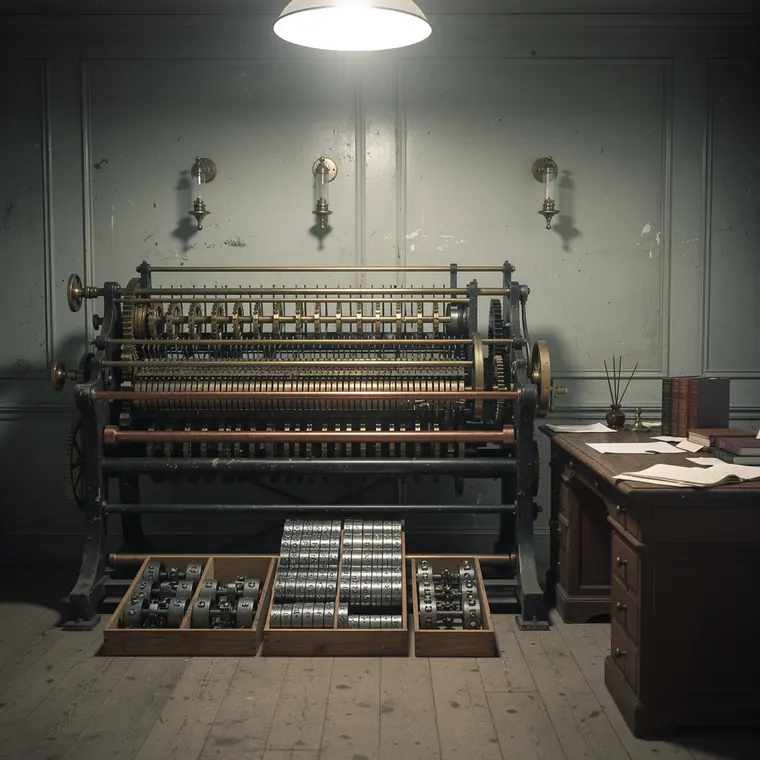
A Scheutz difference engine installed in a government statistical office of 1859, an iron frame with horizontal rows of brass figure wheels and a printing mechanism at one end, a clerk's high sloping desk beside it, trays of freshly stereotyped number plates stacked at its foot, gas brackets on the wall above, a plain panelled wall behind, the floorboards bare, the room in desaturated greys with the brass warm against them, even flat light from directly overhead.
- What it was used for
- A copy of the Stockholm machine, ordered by the General Register Office in London and built by Bryan Donkin and Co., delivered in 1859. The numbering is inconsistent: counted from the model of 1843 it is the third machine, counted from the first full-size machine the second; the sources use both. It was to compute life tables. William Farr first reported on its use in "On the Construction of Life Tables" (Philosophical Transactions 149, 1859, pp. 837-878, read 7 April 1859), while the machine was still under construction. Its main job was the English Life Table of 1864: 6.5 million deaths sorted by age, 500 copies printed.
- What was new
- What was new was not the mechanism - it was a copy - but the place: a calculating machine in the service of a government office rather than in a workshop or at an exhibition. What that service yielded is reckoned up by Doron Swade from a Stationery Office letter of 1864: of the 600 pages of printed tables only 28 were composed entirely by the machine, a further 216 partly; the rest came from the hand. The building went wrong too: £1,200 was granted in 1857, and Donkin delivered in July 1859 some weeks past the deadline and, according to Lindgren, at a loss of £615.
Connections
Every connection names its kind. “Forerunner” on its own would be a claim.
- Follows fromScheutz Difference Engine1853The General Register Office in London ordered a copy of the Stockholm machine. Bryan Donkin and Co. built it, delivery was in 1859, and it was put to work on life tables - the English Life Table of 1864.Source: IEEE Computer Society, Computer Pioneers: (Pehr) Georg Scheutz · Computer History Museum: Georg & Edvard Scheutz (The Babbage Engine)
Further reading
- IEEE Computer Society, Computer Pioneers: (Pehr) Georg Scheutz
- History of Information: William Farr Publishes the First Instances of a Printing Calculator Used in Medical Statistics
- Atticus Rare Books: William Farr, On the Construction of Life Tables (Philosophical Transactions 1859) - bibliographische Beschreibung
- Computer History Museum: Georg & Edvard Scheutz
- Doron Swade: Calculation and Tabulation in the Nineteenth Century: Airy versus Babbage (PhD, UCL 2003)