Scheutz Difference Engine
1853 · Scheutz Machine · Work 496 of 1,871
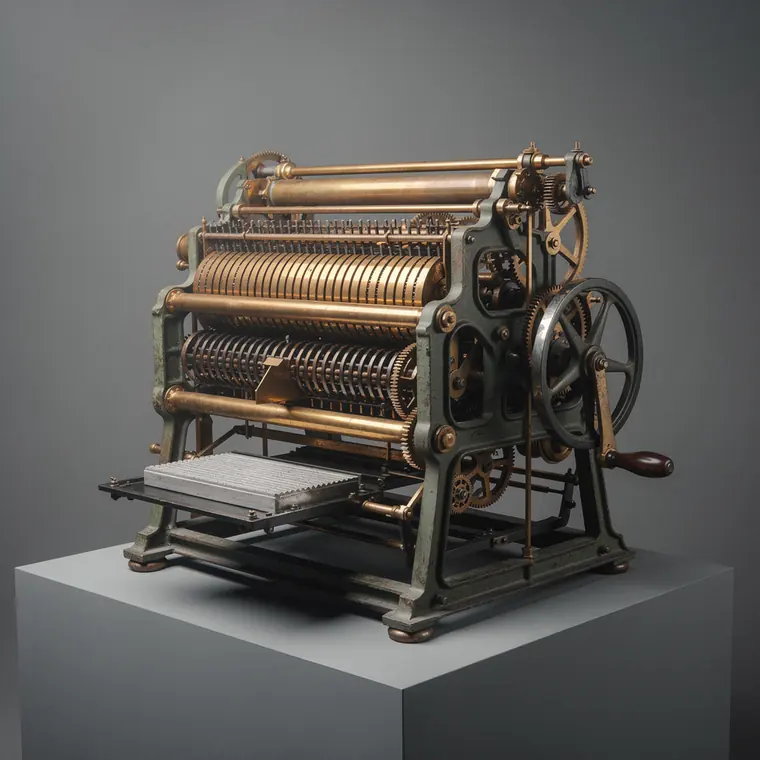
A difference engine of 1853 the size of an upright piano, an iron and brass frame, four horizontal rows of figure wheels one row for each order of difference, fifteen wheels across each row, the rows stacked one above the other on horizontal shafts, a printing mechanism at one end with a small tray for the stereotype mould, a hand crank at the side, the construction plain and light, the engine standing on a plain grey plinth before a flat grey background, even flat light from directly in front.
- What it was used for
- The machine of the Stockholm printer and journal publisher Georg Scheutz and his son, the engineer Edvard, calculated tables and printed them itself. Merzbach describes it as handling numbers of 15 digits and tabulating functions with 4 orders of differences, the fourth being constant; the number wheels stood horizontally in a 15 by 5 array, tabular values in the top row and the differences below. The printing apparatus extended to eight places: it impressed 8-digit figures onto 8-inch strips of papier mache, usually covered with black lead so that stereotype plates could be produced from them. It was completed in October 1853 at J. W. Bergström's mechanical works in Stockholm.
- What was new
- What this machine could do: compute a table and impress the result directly into a printing matrix, so that the figures never passed through a compositor's hand. That does not settle who first printed a table by machine: the oldest surviving automatically produced numerical table is a table of 1849, printed with the Scheutzes' earlier model completed in 1843. The Swedish parliament had granted 3,333 riksdollar and 16 skilling in 1851 - against the £17,500 the British Treasury spent on Babbage's Difference Engine No. 1, according to the Science Museum. The barb: both Scheutzes died bankrupt; their venture contributed to their ruin.
Connections
Every connection names its kind. “Forerunner” on its own would be a claim.
- Follows fromDifference Engine No. 11832In 1834 Georg Scheutz learned the details of Babbage's work on the difference engine from Dionysius Lardner's published account. With his son Edvard he first built a prototype, completed in 1843; the machine engineered in metal was built in Stockholm in 1853 by Johan Bergström to the Scheutzes' plans.Source: IEEE Computer Society, Computer Pioneers: (Pehr) Georg Scheutz · Computer History Museum: Georg & Edvard Scheutz (The Babbage Engine)
Further reading
- Uta C. Merzbach: Georg Scheutz and the First Printing Calculator (Smithsonian Studies in History and Technology)
- Computer History Museum: Georg & Edvard Scheutz
- Science Museum: Charles Babbage's Difference Engines and the Science Museum
- History of Information: The first mathematical table printed by a Difference Engine