Difference Engine No. 1
1832 · Difference Engine, Demonstration Piece · Work 484 of 1,871
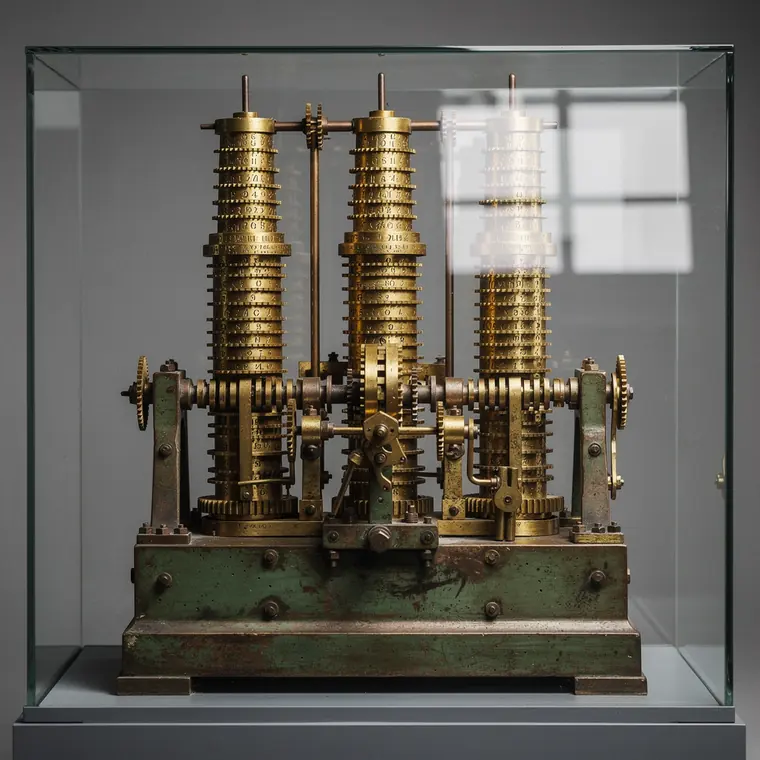
The finished portion of a difference engine, three columns of brass figure wheels each a stack of wheels one above the other rising from a heavy bronze and steel frame, numerals engraved around the rim of every wheel, the columns linked by levers and cams, a plain rectangular base, the whole standing in a plain glass case on a grey plinth before a flat grey background, even flat light from directly in front.
- What it was used for
- The assembled portion of the government's engine, the demonstration piece. The Computer History Museum describes it as a small demonstration assembly delivered to Babbage by Clement in 1832, one seventh of the calculating section and all Babbage had to show after a decade of investment. The Science Museum gives about 2,000 parts, finished in 1832. The statement drawn up by Sir Harris Nicolas from Babbage's papers, printed in his Passages, says that early in 1833 Babbage had a portion of sixteen figures put together, capable of calculating tables having two or three orders of differences; Smiles, by contrast, says it was completed only to a depth of five figures and two orders of differences. Per the Computer History Museum, Babbage used it to develop his ideas on computation and for demonstrations to guests; it supported the feasibility of a full machine.
- What was new
- Not the first calculating machine - stepped-drum machines went back to Leibniz, and Müller's ran in 1784. What was new is that this portion continued a table calculation by itself, step after step, without a hand resetting each value; the Computer History Museum calls it the first successful automatic calculator and one of the finest examples of precision engineering of its time. What it could not do was print: per Smiles only a small part of the proposed printing machinery was ever made. The accounts of its capacity conflict, and the conflict is between Babbage and Smiles, not between museums. The barb is in the part count: the whole machine called for 24,000 parts per the Science Museum, 25,000 per the Computer History Museum; per the Computer History Museum some 12,000 unused precision parts were later melted down for scrap. In January 1843 the finished portion and all the drawings were deposited, by direction of the Government, in the museum of King's College London.
Connections
Every connection names its kind. “Forerunner” on its own would be a claim.
- Follows fromThe Bureau du Cadastre1793Prony had his logarithms produced by a three-tier pyramid of calculators, modelled on Smith's pin factory. Babbage was greatly impressed and proposed replacing the lowest tier with machinery; in 1832 he cited the project as his chief proof that the division of labour reaches mental work as well.Source: Lorraine Daston, Calculation and the Division of Labor 1750-1950 (Bulletin of the German Historical Institute)
- EncounteredThe Workshop of Joseph Clement1830Of the engine only the demonstration portion was ever assembled, delivered by Clement's workshop in 1832 and shown by Babbage to some acclaim. When Clement downed tools in March 1833 after the dispute over moving the workshop, construction was abandoned; of the 24,000 intended parts, some 12,000 finished ones were never used and were later melted down for scrap.Source: Science Museum: Charles Babbage's Difference Engines and the Science Museum · Computer History Museum: The Babbage Engine - A Brief History
- Parallel toMüller's Proposal1786Müller described a printing table machine based on the method of differences in a letter of 18 September 1784; his account of the calculating machine appeared in 1786, edited by Klipstein. Babbage designed his engine out of anger at faulty printed tables. Whether he knew Müller's publication is unknown; a translation by Herschel is held in the British Library.Source: Christine Krause (TU Ilmenau): Das Positive von Differenzen · Neue Deutsche Biographie: Müller, Johann Helfrich von (Deutsche Biographie)
Further reading
- Computer History Museum: The Babbage Engine - History
- Science Museum: Charles Babbage's Difference Engines and the Science Museum
- Charles Babbage, Passages from the Life of a Philosopher (1864), Kap. VI
- Samuel Smiles, Industrial Biography: Joseph Clement (Volltext bei Grace's Guide)
- Science Museum, Difference Engine No. 2 Technical Description (PDF), Abschnitt 1.1 (24.000 Teile der Difference Engine No. 1)
- Heinz Nixdorf MuseumsForum Blog: Johann Helfrich Müller und seine Rechenmaschine