The Workshop of Joseph Clement
1830 · Precision Toolmaking · Work 483 of 1,871
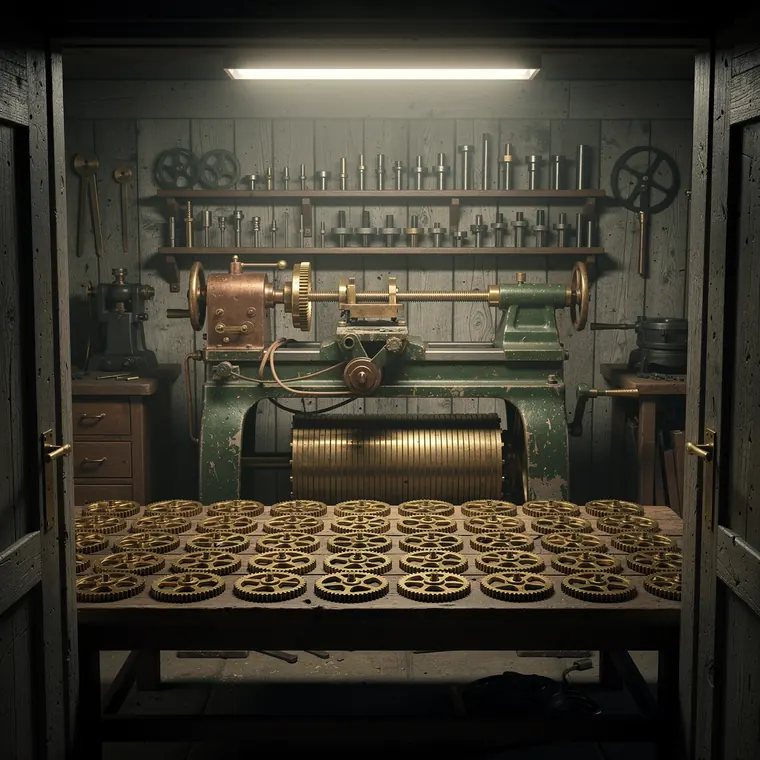
A toolmaker's workshop of 1830 with a heavy screw-cutting lathe at its centre, an iron bed with brass fittings and a treadle and belt beneath, gauges, taps and dies racked on the plank wall behind, rows of identical half-finished brass wheels laid out on a bench in the foreground, each wheel toothed and bright and lying flat, the room in desaturated greys with the brass warm against them, even flat light from directly overhead.
- What it was used for
- Joseph Clement (1779-1844) had worked at Galloways and for Bramah and had been chief draughtsman at Maudslay and Field; in 1817, per Samuel Smiles, he took a small workshop of his own in Prospect Place, Newington Butts, as a mechanical draughtsman and maker of small machinery requiring first-class workmanship. From 1823, on Brunel's recommendation, he built Babbage's Difference Engine No. 1. Babbage wrote in 1863 that Clement's workshop was then his front kitchen, with one small but very good lathe; because Babbage required identity among hundreds and even thousands of similar parts, the existing methods were insufficient, so special tools were arranged and Clement converted a large building behind his house into a workshop. Clement's certificate of 5 December 1827 names eight men on the machine and one on the drawings; Herschel was told in February 1828 that ten were constantly at work, and saw seven.
- What was new
- What was new was not a device but a workshop achievement: repeated parts held to the same dimension. Swade reports that Wright and Bromley took measurements from surviving parts of Difference Engine No. 1 and established that Clement could hold repeated parts within two thousandths of an inch, noting that the notion of a tolerance is an anachronism here: until the 1850s there was practically no standardisation. Added to that was Clement's rule of 1828 that every screw of a particular length should have its appointed number of threads of a settled pitch, reckoned on the inch; per Smiles this was very shortly adopted throughout the trade. The barb: in May 1828 Babbage already wrote down the suspicion that Clement intended to make him pay for the tools and then keep them as his own property. In March 1833, after a dispute over compensation, Clement downed tools and took the tools and drawings with him; Michael Williams records that he undoubtedly had the legal right to take the tools.
Connections
Every connection names its kind. “Forerunner” on its own would be a claim.
- EncounteredDifference Engine No. 11832Clement, a master toolmaker and draftsman, was to make the machine's 24,000 parts. In 1832 his workshop delivered a small demonstration assembly to Babbage, one seventh of the design. In March 1833 Clement downed tools and fired workmen, in a dispute over compensation for moving the workshop closer to Babbage's house.Source: Computer History Museum: The Babbage Engine - A Brief History · Science Museum: Difference Engine No. 2 - Technical Description · Science Museum: Charles Babbage's Difference Engines and the Science Museum
Further reading
- Samuel Smiles, Industrial Biography: Joseph Clement (Volltext bei Grace's Guide)
- Michael R. Williams, Joseph Clement, IEEE Computer Society Pioneers (mit Babbage-Brief 1863 und Herschel-Korrespondenz)
- Doron D. Swade, The Construction of Charles Babbage's Difference Engine No. 2, IEEE Annals of the History of Computing (2005)
- Computer History Museum: Joseph Clement