El Ajedrecista
1912 · Chess Automaton · Work 503 of 1,871
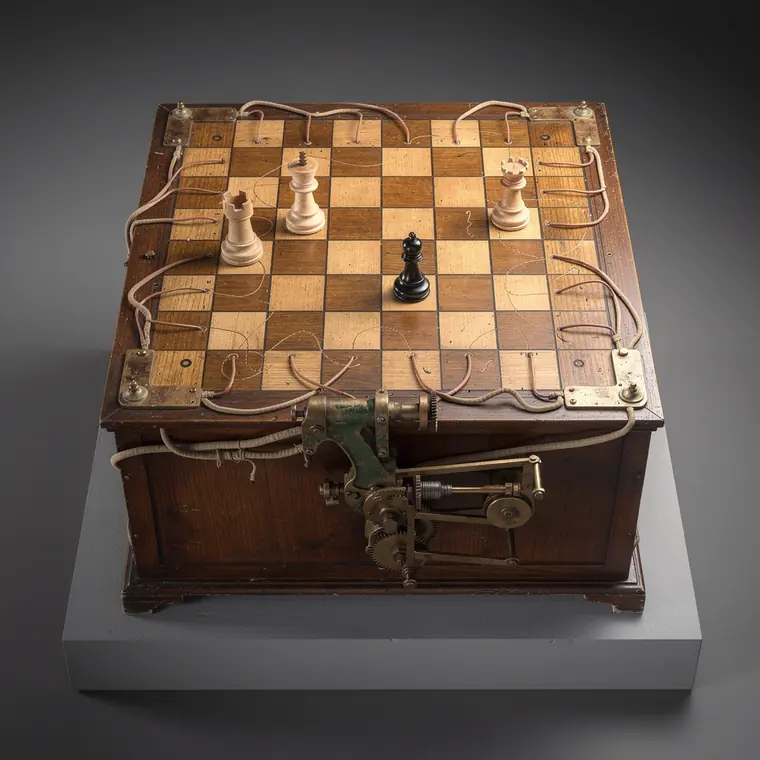
A chessboard mounted on a wooden cabinet, wires running beneath each square, a mechanical arm at one edge of the board, three chess pieces on the board, a white king and rook on one side and a black king on the other, the squares plain light and dark, the cabinet front a plain panel, the cabinet in dark varnished wood, the board seen from directly above, the whole standing on a plain grey plinth before a flat grey background, even flat light from above.
- What it was used for
- El Ajedrecista was a chess automaton built by the Spanish engineer Leonardo Torres Quevedo. It did not play a whole game but only one endgame: king and rook against the bare king, with the machine taking the stronger side. The Museo Torres Quevedo at the Madrid school of civil engineering, which holds the apparatus, states the purpose plainly: Torres Quevedo built it to demonstrate his theories. Electrical contacts in the board reported where the pieces stood; an arm moved its own pieces. It was demonstrated in 1914 in the mechanics laboratory of the Sorbonne in Paris. The second machine of 1920 moved its pieces by electromagnets beneath an ordinary board. It detected wrong moves by its opponent and announced them with an illuminated sign; on the third wrong move it stopped the game, which then had to begin again. A built-in phonograph said "checkmate".
- What was new
- Brian Randell wrote in 1982 in the Annals of the History of Computing that this was believed to have been the world's first chess automaton — believed, because the one apparent earlier automaton, von Kempelen's Turk, turned out to have a small human operator hidden inside. The difference lies not in the chess but in the full automation: the machine sensed the position electrically and made its own moves. Behind it, according to Heinz Zemanek as cited by Herbert Bruderer, lay a six-part algorithm implemented with levers, gears and relays. It always mated, within at most 63 moves according to the Museo Torres Quevedo.
Further reading
- Brian Randell, From Analytical Engine to Electronic Digital Computer: The Contributions of Ludgate, Torres and Bush, IEEE Annals of the History of Computing 4(4), 1982, 327-341 (Newcastle University e-prints)
- Museo Torres Quevedo (ETSI Caminos, UPM Madrid), The Chess Player: The First Computer Game in History
- Herbert Bruderer, AI Began in 1912, blog@CACM (ACM)
- Allison Marsh, This 1920 Chess Automaton Was Wired to Win, IEEE Spectrum, 29.06.2023
- Francisco González de Posada, El aritmómetro electromecánico de Torres Quevedo (1920), primer ordenador, Real Academia Europea de Doctores, 2020