Torres' Arithmometer
1920 · Electromechanical Arithmometer · Work 505 of 1,871
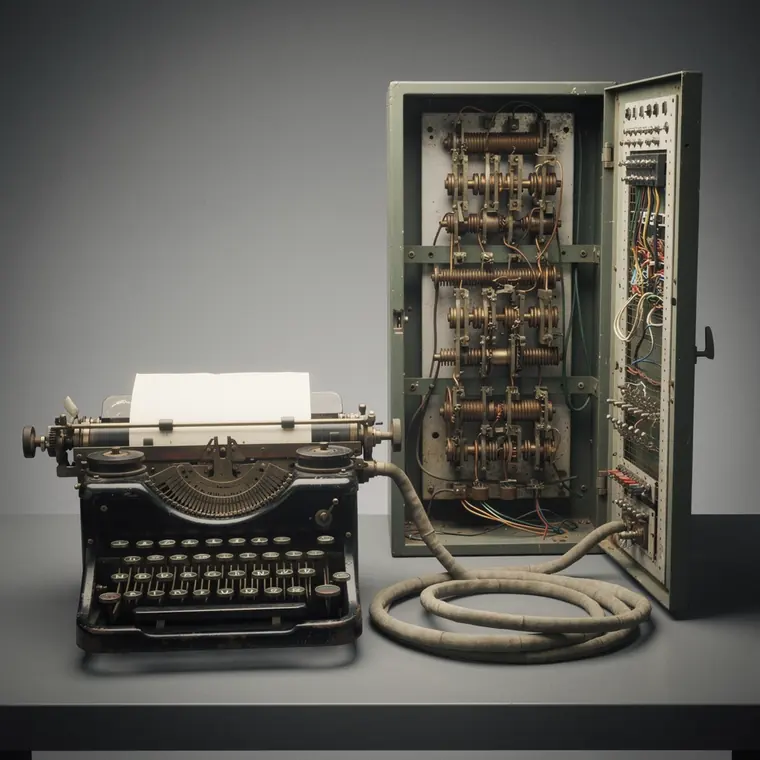
A typewriter connected by a thick cable to a cabinet of relays, the cabinet standing open to show rows of electromagnets and wiring, a plain sheet of paper in the typewriter carriage, the two machines set side by side on the same table, black enamel and brass against grey, the cable looping between them, standing on a plain grey table before a flat grey background, even flat light from directly in front.
- What it was used for
- The electromechanical arithmometer was a demonstration machine. Leonardo Torres Quevedo showed it in Paris on 26 June 1920, at a session of the Société d'Encouragement pour l'Industrie Nationale held to mark the centenary of the first really practical calculating machine, the arithmometer of Thomas de Colmar. He had built it in his Laboratorio de Automática in Madrid. It was operated through a typewriter connected to the arithmetic unit by electrical lines and physically separate from it: one typed in the problem, the machine performed any of the four operations of arithmetic and printed the result itself. According to González de Posada the apparatus had the units that computers of the late twentieth century have: arithmetic unit, control unit, a small store and an output device.
- What was new
- Torres Quevedo stated the difference himself, here in González de Posada's Spanish translation of the French lecture: his apparatus rested on the same principles as that of Thomas de Colmar but worked quite differently, because in his all movements were automatic. The advance lay in the technology: relays instead of gear wheels — and in that he also saw the reason Babbage had failed with purely mechanical means. The machine could also execute conditional instructions; for the automatic division of a five-place number it compared the divisor with the remainder. Randell names the sting: Torres apparently had no thought of making such a machine commercially, and his work had little discernible effect on the later developments leading to the modern computer.
Further reading
- Francisco González de Posada, El aritmómetro electromecánico de Torres Quevedo (1920), primer ordenador, Real Academia Europea de Doctores, 2020
- Brian Randell, From Analytical Engine to Electronic Digital Computer, Annals of the History of Computing 4(4), 1982
- Museo Torres Quevedo (ETSI Caminos, UPM Madrid), The Birth of Computing: Torres Quevedo's Calculating Machines
- Herbert Bruderer, Leonardo Torres Quevedo: A Brilliant but Forgotten Spanish Inventor, blog@CACM (ACM)