Couffignal's Binary Machine
1938 · Binary Design, Unfinished · Work 506 of 1,871
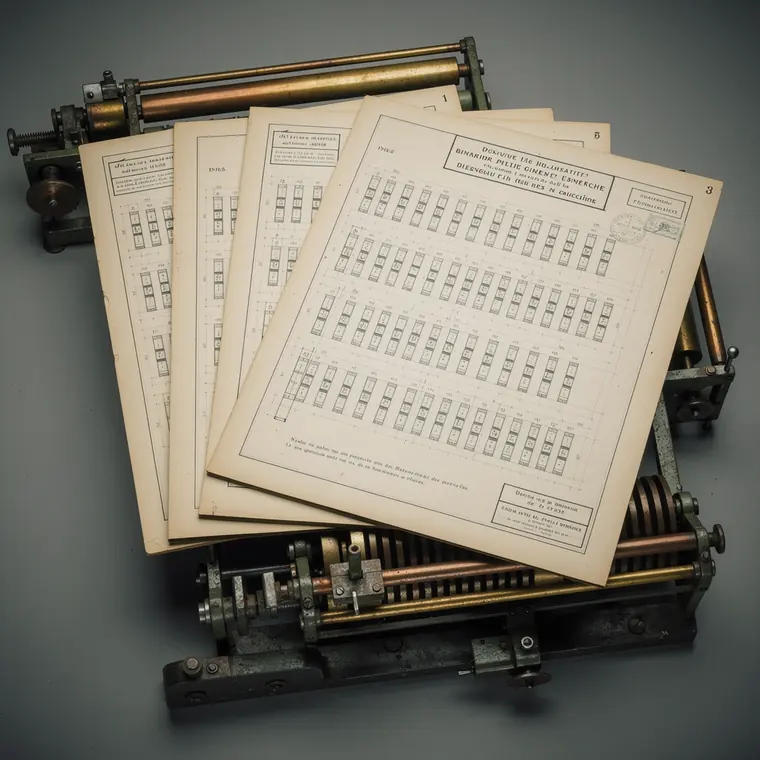
A set of French design drawings for a binary calculating machine, ink on cream paper, plan and elevation, rows of two-position elements repeated across the sheet, each element a small bar with two settings, ruled dimension lines, the title block a plain ruled box, a small plain stamp in one corner, the sheets fanned slightly one over another, laid flat on a grey studio table, even flat light from directly above.
- What it was used for
- Louis Couffignal was a French mathematician. His binary machine is a design on paper, set out in the doctoral thesis he defended on 10 January 1938 and printed in 146 pages under the title "Sur l'analyse mécanique. Application aux machines à calculer et aux calculs de la mécanique céleste". It was meant to compute celestial mechanics, not to keep books: the machines in ordinary use, Couffignal writes, were designed for commercial and banking calculation. One of his worked examples is the conversion of star coordinates from a photographic catalogue, with two women operators entering the values onto a punched tape; for that he gives seven minutes on average, working from a mechanical table of 162,000 numbers divided into twenty part-tables. The machine was never built.
- What was new
- Couffignal's real proposition is not a construction plan but a reversal: the arrangements most favourable to mechanical calculation are, in general, not those that work by the rules of hand calculation. From that followed the binary system, with two stated advantages — it requires far fewer organs than the decimal system, and it allows every hole belonging to one number to be punched in a single line of the tape, which removes the difficulties of decimal punched cards. He names the price himself: a new function, the translation between the number systems. He was not first. Michel Mouyssinat writes that Raymond Valtat was the first to propose using binary notation in calculating machines, with patents from 1931 and a note in the Comptes rendus of 1936; Couffignal, he writes, reacted quickly and presented the work he had until then kept confidential.
Further reading
- Louis Couffignal, Sur l'analyse mécanique. Application aux machines à calculer et aux calculs de la mécanique céleste (Thèse, Paris 1938), Volltext bei Numdam
- Michel Mouyssinat, Neper et le calcul binaire, 1024 – Bulletin de la société informatique de France, Nr. 5, März 2015
- J. A. N. Lee, Computer Pioneers (IEEE Computer Society History Committee), Eintrag Louis Couffignal, Auszug aus Ramunni 1989