Leibniz's Binary Sketch
1679 · Binary Ball Machine · Work 507 of 1,871
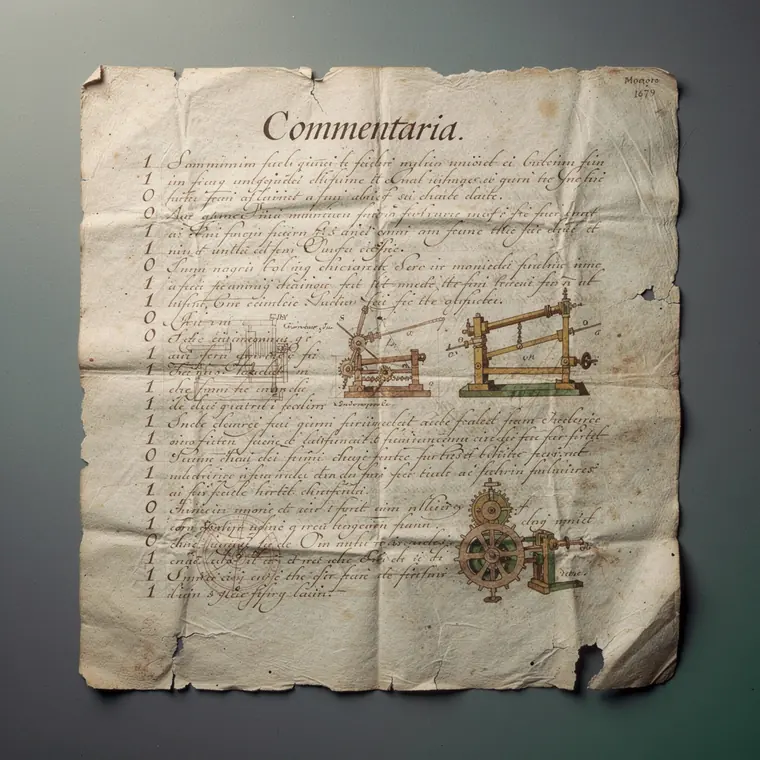
A page of handwritten Latin notes in brown ink, the lines of writing reading as texture, a column of the figures 1 and 0 written down the margin, the paper toned with age, laid flat on a grey studio table, even flat light from directly above.
- What it was used for
- The item is a manuscript by Gottfried Wilhelm Leibniz, "De progressione dyadica", which he dated himself to 15 March 1679; it lies in the Leibniz papers under the shelfmark LH 35, III B 2, sheets 1 to 4. The text deals first with the binary number system and with arithmetic in it. The machine appears as an aside: Leibniz writes that calculation of this kind could be done by a machine — a perforated box whose holes can be opened and closed, open where the ones are and closed where the zeros are; through the open holes small balls drop into grooves that stand for the columns. No prototype survives. A drawing one could build from was made only by Ludolf von Mackensen; according to the lecture abstract by Erwin Stein, the Deutsches Museum in Munich produced a model in 1971.
- What was new
- What the design could do that Leibniz's own four-function calculating machine could not: calculate without gear wheels. Clara Silvia Roero and Erika Luciano describe the mechanism — only rolling balls, no wheels, no electrical impulses; in the model built from Mackensen's drawings the carry arises because the weight of two balls meeting in one position presses a spring down, whereupon the first ball falls into the collecting tray and the second rolls on to the next column. Priority is contested: Mouyssinat writes that before Leibniz, Napier had proposed binary notation in his calculation "by the chessboard". The price was the same one Couffignal was still working on in 1938: conversion between decimal and binary numbers. The manuscript has still not been fully edited. According to the Leibniz manuscript project PHILIUMM no complete transcription of it exists even now; of over 170 manuscript sheets on dyadics, less than ten per cent have been transcribed.
Further reading
- PHILIUMM (ERC Advanced Grant 101020985), De Progressione Dyadica – Übersicht und Handschriftenverzeichnis
- PHILIUMM, Manuscripts on Dyadica
- C. S. Roero / E. Luciano, Leibniz e Peano. Dalla numerazione binaria alle macchine, Lo Sguardo Nr. 32 (2021)
- Erwin Stein (Leibniz Universität Hannover), Vortragsabstract Johannes-Kepler-Symposium, Univ. Linz, 10.11.2005
- C. S. Roero / E. Luciano, Leibniz e Peano. Dalla numerazione binaria alle macchine, Lo Sguardo Nr. 32 (2021), PDF beim Verlag
- Michel Mouyssinat, Neper et le calcul binaire, 1024 – Bulletin de la société informatique de France, Nr. 5, März 2015
- Louis Couffignal, Sur l'analyse mécanique (Thèse, Paris 1938), Numdam