The Passage on Music
1843 · Speculation · Work 509 of 1,871
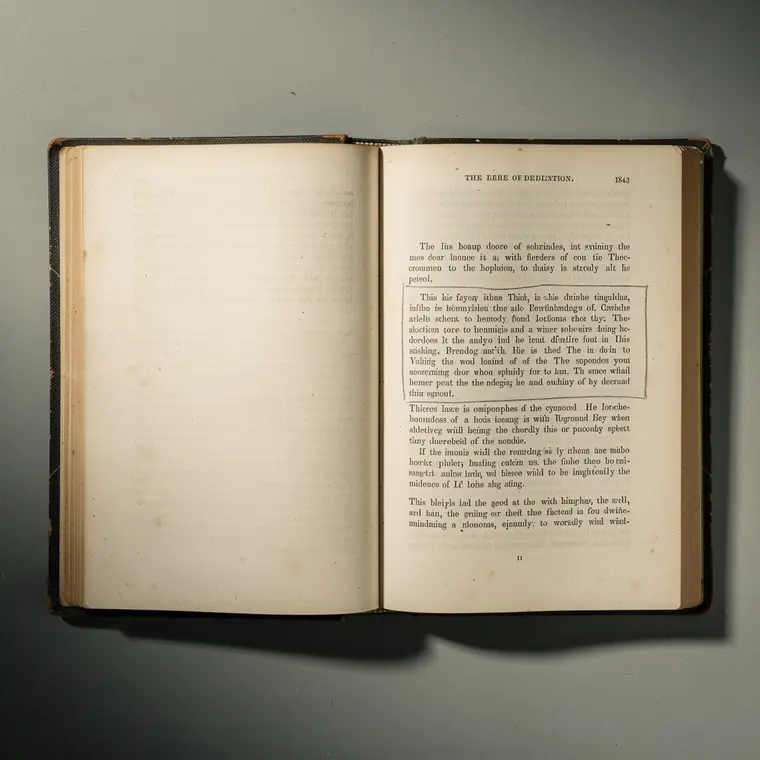
A printed page of 1843 in a single plain column of type, one paragraph marked with a pencil bracket in the margin, the rest of the page plain, the paper cream and lightly toned, the book lying open with its facing page also plain type, the binding dark cloth, the margins wide and cream, the type small and even, the book laid flat on a grey studio table, even flat light from directly above, the book alone in the frame.
- What it was used for
- The passage stands in Note A, the first of Ada Lovelace's notes, on page 694 of the original printing in Taylor's Scientific Memoirs, volume III. Note A separates the Difference Engine from the Analytical Engine and introduces the term "science of operations". The sentence on music is the example given there of the engine acting on things other than number. As printed it reads: "Supposing, for instance, that the fundamental relations of pitched sounds in the science of harmony and of musical composition were susceptible of such expression and adaptations, the engine might compose elaborate and scientific pieces of music of any degree of complexity or extent." The sentence is not Menabrea's, whose translated text ends on page 690, but belongs to the translator's notes; Note A is signed A. A. L.
- What was new
- What is new is not the claim that the engine will make music — it makes no such claim. The sentence is conditional, and the conditions belong to the quotation. The sentence before it says: it might act upon other things besides number, were objects found whose mutual fundamental relations could be expressed by those of the abstract science of operations, and which should be also susceptible of adaptations to the operating notation and mechanism of the engine. Only then comes the sentence on music, and it too begins with "supposing". What is new is the generalisation itself: that a calculating engine is not bound to number but to whatever relations can be expressed in its notation. Fuegi and Francis write in 2003, plainly, that Babbage concentrated on the number-crunching possibilities while Lovelace went beyond them.
Further reading
- Scientific Memoirs, Vol. III (1843), Note A, S. 694 (Originaldruck, Scan; Seitenbild geprüft)
- Transkription, Classics in the History of Psychology, York University (Kontrolltext)
- J. Fuegi / J. Francis, Lovelace & Babbage and the Creation of the 1843 Notes, IEEE Annals of the History of Computing 25(4), 2003