Gare du Nord
1866 · Cast Iron Columns with Arched Trusses · Work 51 of 1,871
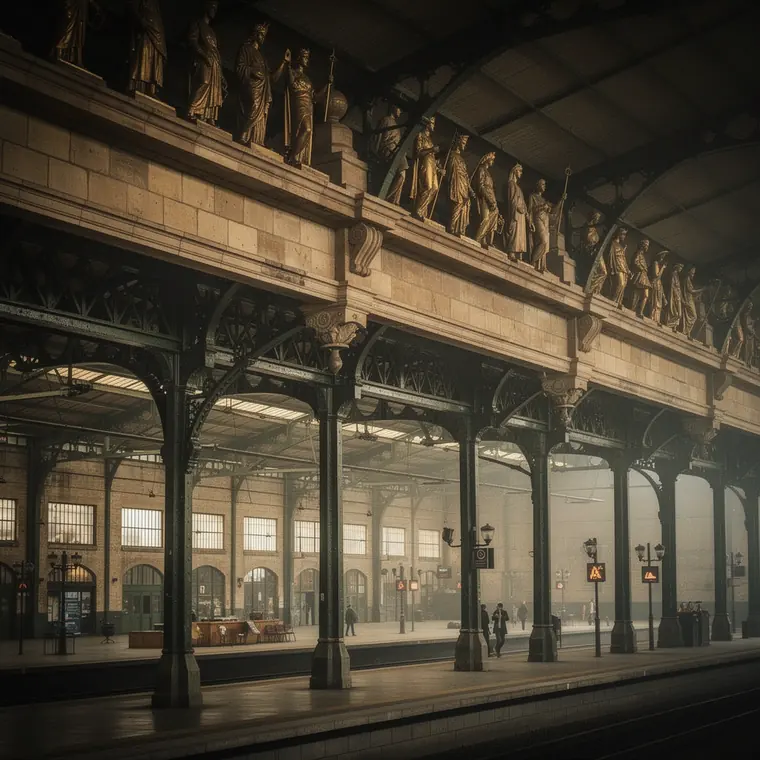
The Gare du Nord in Paris, cast iron columns carrying the shed trusses over the platforms, the stone facade above crowned with twenty-three statues personifying northern cities.
- What it was used for
- Terminus of the Compagnie des chemins de fer du Nord, serving northern France and Belgium. Its 1846 predecessor was above all a goods station for coal and steel from the northern French coalfields. Hittorff's replacement went up from 1861 over eight platform tracks; the shed is about 200 m long, its trusses span some 35 m, and the cast-iron columns came from a Glasgow foundry (Alston & Gourlay, 1862). The 23 female statues on the stone facade stand for the cities served, from Amsterdam and Brussels to Berlin, Vienna and Warsaw; the statues alone cost 82,000 francs. The station was perpetually too small: enlarged to 13 tracks in 1877, 18 in 1889, 28 in 1900. The old station's stone facade was not demolished but taken down and re-erected in Lille, where it still forms the Gare de Lille-Flandres.
- What was new
- The truss span of about 35 m clearly exceeded its Paris predecessors: the Gare de l'Est of 1852 managed some 30 m, King's Cross in London 32 m. What was new was less the structure than the division of roles - a stone facade modelled on a triumphal arch as a city gate in front, the bare iron shed behind. Hittorff did not invent the motif of city statues; the Gare de l'Est already carried figures for Strasbourg and Verdun. Contemporaries found the juxtaposition of classical facade and industrial shed awkward.
Further reading
- Cité de l'architecture et du patrimoine: La gare du Nord, un chef-d'oeuvre de modernite architecturale
- Ville de Paris: Sept realisations emblematiques de Jacques-Ignace Hittorff
- SNCF Patrimoine: Gares et reseau ferre
- POP / Base Mérimée, Ministère de la Culture: Gare du Nord (PA00086492)
- Clive Lamming: La gare du Nord, monument historique et grande gare europeenne
- Guichet du Savoir, Bibliotheque municipale de Lyon: Spannweiten Pariser und Londoner Bahnhofshallen