Plankalkül
1945 · Programming Notation · Work 513 of 1,871
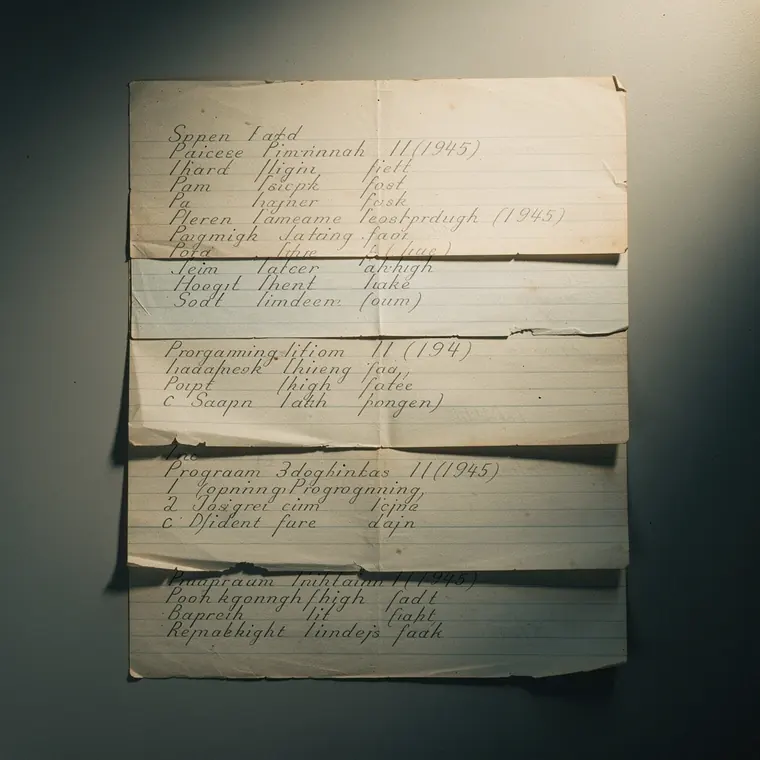
Handwritten pages of a programming notation set out in stacked rows, each statement written on several lines one above another with index lines beneath the main line, pencil on plain ruled paper, the rows aligned in columns down the page, several sheets overlapping, the edges of the sheets slightly worn, the sheets laid flat on a grey studio table, even flat light from directly above, the sheets alone in the frame.
- What it was used for
- The Plankalkül is a notation for writing down computational procedures, devised by Konrad Zuse when he could not work. Friedrich L. Bauer and Hans Wössner describe the situation: in May 1945 Zuse had arrived with his relay computer Z4 at the little village of Hinterstein in the Allgäu Alps, immobilized by the postwar situation and prevented from pursuing his business, and so found time to resume his 1943 studies. The notation was not meant chiefly for numerical work. According to Wolfgang K. Giloi, Zuse himself wrote that his interest lay less in numerical applications, which were trivial to him, than in logical problems; chess alone takes up 44 pages of the manuscript. According to Bauer and Wössner the Plankalkül did not lead to practical use. Before 1972 only short papers were printed, among them nine pages in Archiv der Mathematik 1948/49 and four pages in Elektronische Rechenanlagen 1959; the full text appeared in 1972 as a report of the GMD, 285 pages.
- What was new
- Bauer and Wössner give the difference and the price in one breath in 1972: the Plankalkül turns out to be a highly developed programming language with structured objects built from a single primitive mode, the two Boolean values 0 and L; conceptually this is advantageous, but the plurality of modes in predominant programming languages indicates the practical weakness of the approach. The structuring of objects, they write, has only recently come into existing programming languages, and others have yet to come; references as objects were missing in ALGOL 60. Giloi calls the Plankalkül the first high-level programming language, and in the title of a 1997 paper of his own also calls it "non von Neumann". Bauer and Wössner had written in 1972 that to assess it historically one has to compare it with the flow diagram symbolism that originated at about the same time in the United States.
Further reading
- F. L. Bauer / H. Wössner, The Plankalkül of Konrad Zuse: A Forerunner of Today's Programming Languages, Communications of the ACM 15(7), Juli 1972, S. 678–685
- Wolfgang K. Giloi, Die Ungnade der frühen Geburt – in memoriam Konrad Zuse (1910–1995), Akademievorlesung 12.12.1996, Berichte und Abhandlungen der BBAW 4 (1997), S. 97–110
- Computer History Museum, Katalogsatz 102709314: Konrad Zuse, Der Plankalkül, GMD 1972, 285 Seiten
- Deutsches Museum, Archiv, Nachlass Zuse NL 207/0313: The Plankalkül, 1973–01.02.1976, 246 Bl.