The Errors in the Drawings
1989 · Reconstruction Project · Work 515 of 1,871
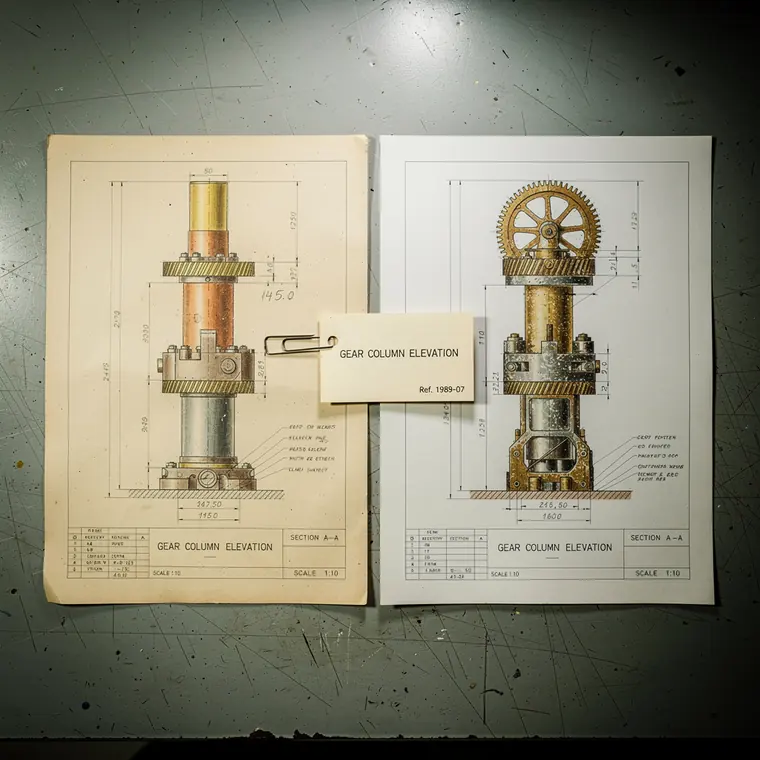
Two versions of the same detail drawing laid side by side, ink on cream paper, the older sheet toned darker, one dimension on the older sheet circled in modern pencil, a small plain card clipped between the two sheets, both drawings showing the same gear column in elevation, ruled dimension lines on both, the title blocks plain ruled boxes, both sheets laid flat on a grey studio table, even flat light from directly above, the two sheets alone in the frame.
- What it was used for
- The twenty original design drawings for Difference Engine No. 2 are the only source for that machine; Babbage, as Doron Swade puts it, provides almost no other explanation, textual description or justification for the design. Anyone who wants to build it must therefore decode them, and that is what Swade and the engineer Reg Crick did — Crick played the major part in producing the modern piece-part drawings and in supervising the construction. He kept an Engineer's Log, the Red Book, an episodic diary of notable issues. Swade's technical description of 1996, Science Museum Papers in the History of Technology No. 5, records the design and engineering decisions made in preparing those drawings; it grew out of a series of debriefing sessions with Crick. Swade states that in 1989 the cost of manufacturing the parts without the printer was estimated at £250,000.
- What was new
- Swade lists the deficiencies of the drawings: dimensioning inconsistencies, the same parts shown differently sized in different views; incompletenesses in the design, omitted devices, redundant assemblies; and design errors, one of which is central to the fundamental operation of the engine. That one sits in the warning mechanism of the tens carry. The curved warning limb as drawn in 171 will, Swade writes, be correctly operated by anticlockwise rotation of the figure wheel and not by clockwise rotation; clockwise rotation during addition is therefore inconsistent with correct warning action, and the mechanism will not work if made as drawn. Swade calls it an apparently serious design flaw. He sets the qualification beside it himself: none of these deficiencies compromises the validity of the basic logic, design or intended function; the gap is one of engineering completeness rather than logical or operational principle. The twenty sheets became some fifty working drawings.
Connections
Every connection names its kind. “Forerunner” on its own would be a claim.
- Follows fromDifference Engine No. 2, the Design1849From 1985 the Science Museum built Difference Engine No. 2 faithfully to Babbage's designs of 1847-49. His twenty large design drawings were insufficiently detailed to serve as manufacturing drawings: tolerances, methods of manufacture, choice of materials and finish are not specified. New drawings were made for each of the 8,000 parts.Source: Computer History Museum: The Engines - A Modern Sequel
Further reading
- Doron Swade, Charles Babbage's Difference Engine No. 2 – Technical Description, Science Museum Papers in the History of Technology No 5, September 1996 (Preface/Foreword)
- Ebd., Abschnitt Calculation, Unterabschnitt Design Error
- Doron Swade, The building of a time machine, Times Higher Education, 14.01.2000 (Kostenschätzung 1989)
- Computer History Museum, A Modern Sequel (Babbage-Projekt)