Difference Engine No. 2, the Design
1849 · Difference Engine, Second Design · Work 486 of 1,871
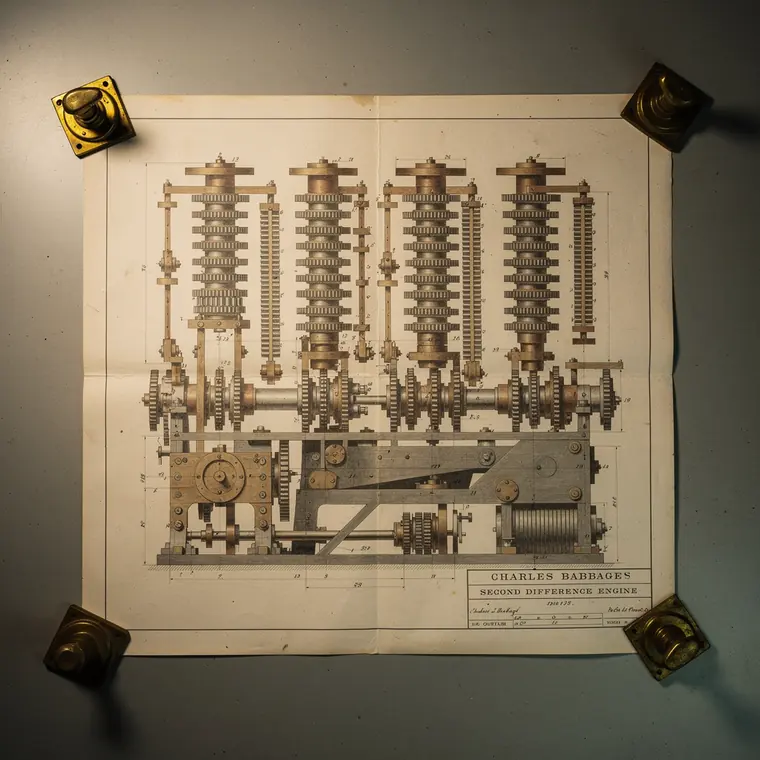
A general arrangement drawing of the second difference engine, an engineering drawing in ink on cream paper, plan and elevation on the same sheet, eight columns of figure wheels drawn side by side, each column a stack of wheels one above the other, ruled dimension lines, wash shading in grey, the title block a plain ruled box, places where lines have been scraped out and redrawn, the sheet laid flat on a grey studio table, even flat light from directly above.
- What it was used for
- A design, not a machine. The Science Museum dates it to 1846-49. Per its technical description the engine calculates and tabulates any 7th-order polynomial to thirty-one decimal places; the output apparatus automatically typesets the results, prints an inked copy of each result on a paper roll and produces stereotype moulds. 8,000 parts of bronze, cast iron or steel, five tonnes, eleven feet long and seven feet high. Against Difference Engine No. 1, three times fewer parts for similar calculating capacity: 8,000 against 24,000.
- What was new
- No new calculating principle - the method of differences stayed the same. What was new was the ratio of effort to capacity: a third of the parts for the same work. What was also new was the demonstrability Babbage claimed for it: Difference Engine No. 2, he wrote, is entirely described by the aid of his Mechanical Notation, which had placed the construction of machinery in the rank of a demonstrative science. The barb is double. Babbage offered the designs in 1852 in a letter to the Prime Minister, Lord Derby; the offer was rebuffed. And when the design was finally built, it was built largely without the means to which Babbage ascribed its provability: the Science Museum worked from the drawings, turning to the notations only as a last resort; metal was first cut for a trial piece in December 1986, the calculating section was completed in 1991 and the output apparatus in March 2002 - 153 years after the design.
Connections
Every connection names its kind. “Forerunner” on its own would be a claim.
- Follows fromDifference Engine No. 11832Between 1847 and 1849 Babbage completed the design of Difference Engine No. 2, an improved version of the first. The design called for only about a third of the parts required by Difference Engine No. 1 while providing similar computing power.Source: Computer History Museum: The Babbage Engine – The Engines
- Works withThe Printing Apparatus1849The printer belongs to the design of Difference Engine No. 2; Difference Engine No. 2 and the Analytical Engine share the same printer design. It produces an inked hardcopy on paper as a checking copy and also automatically stereotypes the results.Source: Computer History Museum: The Babbage Engine – The Engines
- Follows fromMechanical Notation1826Babbage read the sign language to the Royal Society on 16 March 1826 ("On a Method of Expressing by Signs the Action of Machinery") and later called it his Mechanical Notation. With three descriptive forms - drawings, Trains and Cycles - he specified Difference Engine No. 2, whose main drawings date from 1847-9.Source: Charles Babbage: Passages from the Life of a Philosopher (1864), Kapitel 9, Of the Mechanical Notation · Science Museum: Difference Engine No. 2 - Technical Description