The First Column Turned
1991 · Difference Engine No. 2 · Work 516 of 1,871
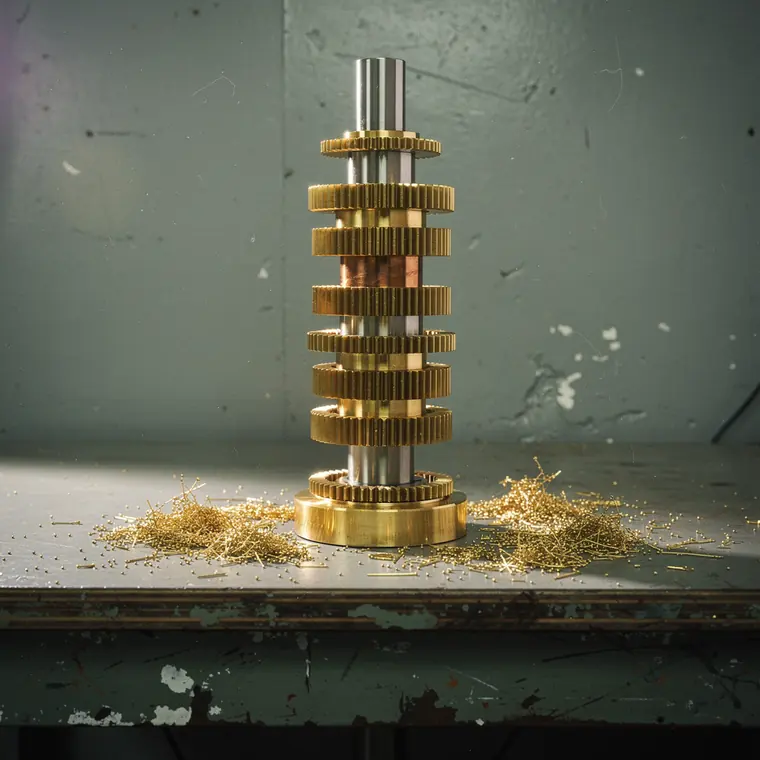
A single column of a newly made difference engine standing on a workshop bench, a stack of bright brass figure wheels one above the other on a steel shaft, the metal freshly machined, brass swarf on the bench surface beside it, the bench top grey and plain, a flat grey wall behind, the teeth of the wheels sharp and the shaft ends bright, even flat light from directly in front, the column alone in the frame.
- What it was used for
- In June 1991 the calculating section of Difference Engine No. 2 was finished, not the machine. So the object record of the Science Museum Group for inventory number 1992-556 states: designed 1847 to 1849 by Charles Babbage, built by the Science Museum, the main part completed in June 1991 for the bicentennial year of Babbage's birth; the printing mechanism was constructed and added only in 2002. The calculating section is driven by a human operator turning a large crank handle at one end. Doron Swade gives the run-in speed of operation as ten complete engine cycles per minute, that is one tabular calculation every six seconds, equivalent to forty turns of the handle per minute with the four-to-one reduction gear in use.
- What was new
- The machine has a window of working speed, and Swade's build report says so: run faster, and the detent wheel of the intermittent drive of the carry axes tends to overshoot and jam the drive; run erratically or slower, and the lowered sectors tend not to mesh cleanly with the figure wheels, and jams occur again. One fault appeared only in the multiple assembly: on the trial piece the figure-wheel drive arms did not foul the internal nibs, but with multiple stacks lowering the axes produced consistent jamming, especially with wheels set at 0 or 9; chamfering the undersides of the arms solved it. And the price of the deadline: Swade writes that they reluctantly abandoned the idea of building the printing apparatus for the bicentenary and lowered the target to the calculating section only — Babbage had done the same. Without the printer, which is integral to the engine, it remained incomplete.
Further reading
- Science Museum Group Collection, Objektsatz Babbage's Difference Engine No 2, Inventarnr. 1992-556
- Doron Swade, Charles Babbage's Difference Engine No. 2 – Technical Description, Science Museum Papers No 5 (1996), Abschnitt Build
- Doron Swade, The building of a time machine, Times Higher Education, 14.01.2000
- James Donnelly, A Modern Difference Engine, Armstrong Publishing, Corvallis 1992 (Teilezahl und Gewicht des Rechenwerks)