Ein freier Mann
1869 · Ermen & Engels · Work 520 of 1,871
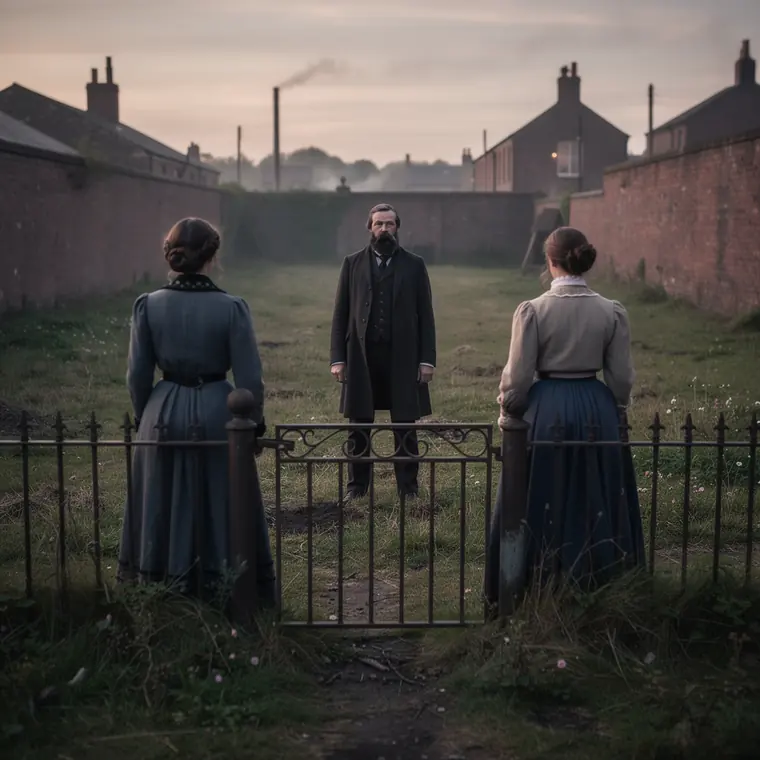
A small rough grass field on the edge of Ardwick, Manchester, early evening of 30 June 1869, low warm sun at the left, a pale hazy summer sky tinged brown by coal smoke, far across the field red-brick terraces and tall mill chimneys trailing thin smoke, the camera just inside a low iron garden gate, at the left edge a brick gatepost and the corner of a red-brick terraced house with flowers on a windowsill and a young tree, in the near foreground the backs of two women at the gate in long dark dresses of 1869, seen from behind, and coming toward the gate across the field, in the centre of the frame between their two heads, about twenty paces away, visible from boots to head, the man, a man of forty-eight with a full dark beard and dark hair combed back, bare-headed, in a dark double-breasted frock coat, dark trousers and boots, his right arm raised high holding a walking stick up in greeting, singing, his face beaming and turned toward the camera.
- Who
- Friedrich Engels (1820–1895) was a merchant, businessman and revolutionary – and Karl Marx's closest collaborator. Born in Barmen, now part of Wuppertal, the son of a textile manufacturer, he came to know the lives of factory workers from 1842 in his father's cotton mill in Manchester; his book "The Condition of the Working Class in England" appeared in 1845. With Marx he wrote the "Communist Manifesto" in 1848, and in 1849 he took part in the risings in Baden and the Palatinate. He then worked for some twenty years in Manchester for the firm of Ermen & Engels, first as an employee, from 1864 as a partner, and supported Marx and his family from his income. He married Lizzie Burns, for whom he had rented a house in Manchester, in 1878, the day before she died. After Marx's death he edited the second and third volumes of "Capital" (1885 and 1894); his "Anti-Dühring" summed up Marxism like an encyclopaedia. Communist dictatorships that cost millions of lives later invoked Marx and Engels. Engels died in London on 5 August 1895.
- The moment
- On 30 June 1869 Engels's partnership agreement with Gottfried Ermen expired. It was his last day as a merchant of the cotton-thread firm of Ermen & Engels in Manchester, whose office he himself called a gloomy room in the warehouse, looking out on the courtyard of an ale-house. He had worked there six days a week, from ten till four. In the morning Ermen gave way on every point in the final negotiations; in the afternoon Engels drove with him to the mill and drank a bottle of Scharzhofberger at his house. Eleanor Marx, Karl Marx's youngest daughter, was staying with him. She remembered how that morning he had cried "For the last time!" in triumph as he put on his boots. Hours later they stood at the garden gate and saw him coming over the little field opposite the house, swinging his stick in the air, singing, his face beaming. That is the moment in the picture. The next day Engels wrote to Marx: "Hurrah! Today doux commerce is at an end, and I am a free man."
- The other side
- The freedom had been paid for by the machine. In the end Engels was entitled to a fifth of the thread mill's profits; on leaving he received £1,750 for letting Ermen keep the firm's name and for not competing with him for five years. As early as November 1868 he had written to Marx that he meant to devote this sum, if need be entirely, to Marx's support: £350 a year for five or six years. The thread business thus paid for the critic of capital. Nor was Engels quite free yet: the accounts and the lawyers kept him going into town for weeks, and Ermen invited him to come to the office as often as he liked.
What the sources leave open: Eleanor Marx wrote her recollection in 1890, twenty-one years later, without date or street; the 30th of June follows from Engels's letters. House and field in Mornington Street have been demolished and built over and are typified in the picture. Who stood beside her at the gate she does not say. The weather that day has not been verified. Engels's letter to Marx is quoted from the English collected works; the German original was not consulted.
Further reading
Sources
- Deutsches Historisches Museum, LeMO: Friedrich Engels (1820–1895), Biografie
- Engels, The Condition of the Working Class in England (Leipzig 1845) – Marxists Internet Archive
- Die Landesbeauftragte zur Aufarbeitung der SED-Diktatur Sachsen-Anhalt, Pressemitteilung A 10/2018 (Marx, 'im Bund je nach Anlass mit Engels und/oder Lenin', als theoretische Grundlage kommunistischer Diktaturen)
- MECW Bd. 43 (Volltext-PDF, libcom): Engels an Marx 29.11.1868 (350 Pfund jährlich), 22.6.1869, 1.7.1869; Engels an die Mutter 1.7.1869 (1.750 Pfund, Konkurrenzverzicht, Kontor, Scharzhofberger, Ermens Einladung); Marx an Engels 3.7.1869; Anm. 316
- The London Gazette, 17. August 1869, Issue 23527, S. 4661 – Auflösung der Partnerschaft Ermen and Engels zum 30. Juni
- Eleanor Marx-Aveling, 'Frederick Engels' (1890), in: Reminiscences of Marx and Engels, Moskau o. J., S. 185–186 – Internet Archive
- Paul Lafargü, Frederick Engels (1905) – Kontorzeiten 'from ten till four' – Marxists Internet Archive
- Tiago Mata / Robert Van Horn, Capitalist Threads: Engels the Businessman and Marx's Capital (UCL Discovery) – Gewinnanteile bis 20 Prozent ab 1864