The Hansen Writing Ball
1867 · Malling-Hansen Skrivekugle · Work 521 of 1,871
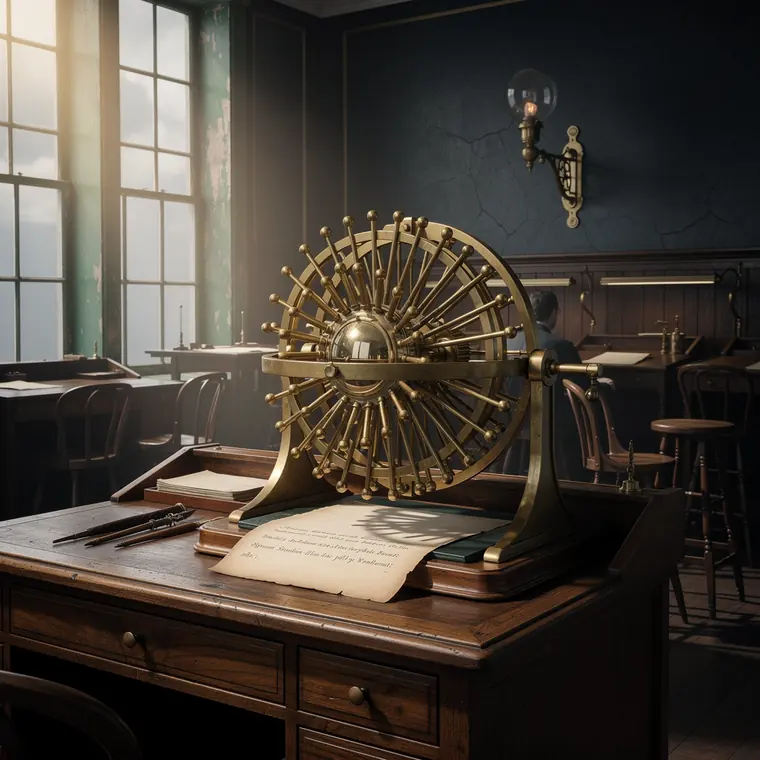
A brass hemisphere studded with radiating key rods, fifty-two of them set in concentric rings so the whole dome bristles like a sea urchin, each rod ending in a small round cap, the dome mounted on a curved frame above a small platen on a polished wooden base, a sheet of paper curling from beneath the dome with a few lines of faint type on it, the machine standing on a slanted writing desk of dark oak, a brass gas bracket on the wall behind, its glass globe dim, tall sash windows admitting grey daylight from the left, the desk surface bearing a pen tray and a small stack of plain paper, the room continuing into shadow past rows of high clerks' stools and stand-up desks.
- What it was used for
- The writing ball was a typewriter in the shape of a brass hemisphere: the keys sit radially on the dome, each one a piston striking downward onto the paper at the centre. It was built by Rasmus Malling-Hansen, a pastor and teacher at the Royal Institute for the Deaf-Mute in Copenhagen. On the account of the Klassik Stiftung Weimar, he arrived at the arrangement from watching how fast his deaf pupils spelled with their fingers. Danish newspapers in September 1870 recommended the device for large offices, for public meetings, and for shorthand and telegraphy. Around 180 were built and about 30 survive. Its best-known owner was Friedrich Nietzsche: his sister bought him one because he could barely read his own handwriting any more, and it reached him in Genoa in February 1882.
- What was new
- Typewriters were no novelty in 1870; others had already tried. What was new was that this one was built in series - the Klassik Stiftung Weimar calls it the first serially manufactured writing device - and that the keys sit on a sphere, so all of them are within the fingers' reach without the hand moving. How fast it really was stayed a claim: "Folkets Avis" wrote on 9 September 1870 that one wrote at least five to six times faster than with a pen, and "Dagbladet" on 20 September that one wrote faster than one speaks. The early models worked with electromagnets, the tall 1875 model purely mechanically. The barb is Nietzsche. He could not find the keys without looking, had to correct constantly in pencil or ink, and put the ball aside after six weeks and barely sixty typed pages.
What the sources leave open: The year is disputed. The Klassik Stiftung dates the development to 1865 and the patent to 1870; the Malling-Hansen Society lists Danish patents from 1864 to 1884 and patents in Saxony (2 June 1870), Baden and Bavaria; "Dagstelegrafen" reported on 9 September 1870 that the first specimen was finished on 2 September. For 1867 the Society cites only early articles dating a lost table model to 1867-69, without proof.