Blickensderfer No. 5
1893 · Type Wheel · Work 525 of 1,871
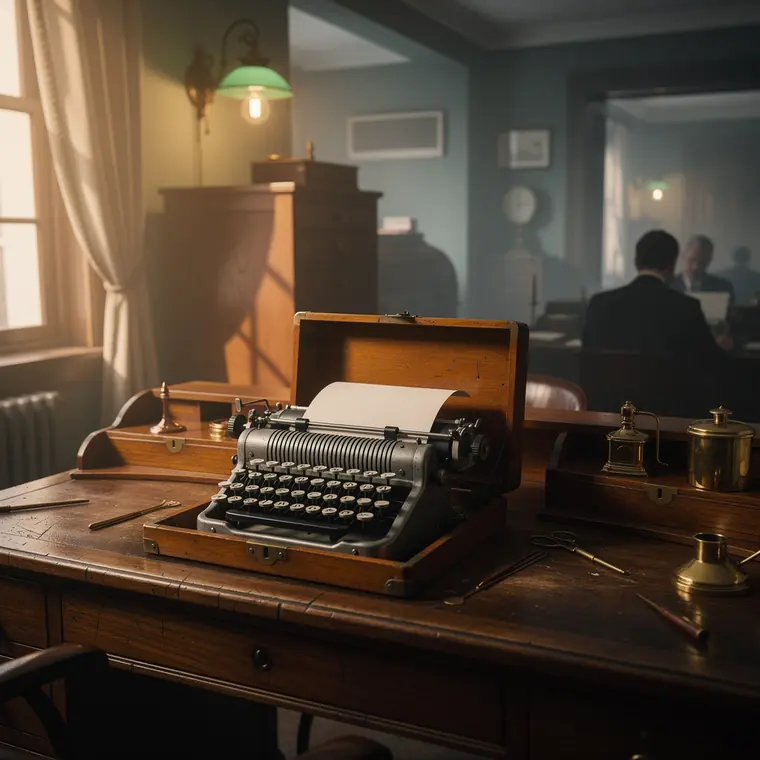
A small aluminium typewriter with a single cylindrical type wheel in place of typebars, the wheel a short ribbed drum standing above the platen, an inking roller pressed against it, three straight rows of keys, each key cap bearing a single capital letter, the machine standing in its open wooden travelling case, the lid propped back on its hinges, a plain sheet of paper in the platen, the case set on a flat oak desk beside a window on the left, an early electric bulb in a green glass shade on a bracket above, a letter tray and a brass inkstand beside the case, a vertical cabinet and a roll-top desk beyond, the far reach of the office in dim grey with dark unlit figures at their desks.
- What it was used for
- The Blickensderfer No. 5 was a portable typewriter from Stamford, Connecticut, built by George Canfield Blickensderfer, who had patented the basis of his design by 1889. It appeared in 1893, cost thirty-five dollars, weighed about ten pounds and had two hundred and fifty moving parts. Instead of separate type bars it carried a single type wheel of hard rubber, a cylinder about 1 3/8 inches in diameter and 5/8 of an inch tall. At a keystroke the wheel turns to the character, tilts down, brushes a small inked roller on the way and strikes the paper - and the writing is visible as it happens. The bottom row of keys read DHIATENSOR, the so-called "Scientific" arrangement; the magazine Invention & Technology states that these letters make up seventy per cent of written English. Over two decades the firm sold nearly two hundred thousand machines.
- What was new
- The type wheel was not new: John Jonathan Pratt built a machine with a type wheel in 1863, James B. Hammond put a type-element machine on the market in 1881, and Lucien S. Crandall one with a type sleeve in the same year. What was new was what this construction added up to: a type element that can be changed, so other founts and other alphabets on the same machine; ink from a roller instead of a ribbon; visible writing; and a weight you can travel with. The barb: type-bar machines grew sturdier, jammed less and over the years proved faster. The keyboard ordered by letter frequency did not prevail either; with touch typing the arrangement lost its advantage. The electric Blickensderfer of 1902, a hundred and twenty-five dollars with a 1/40-horsepower motor, did not sell. The firm went bankrupt and Remington took over its assets in 1926.
What the sources leave open: Nearly all the figures appear only in one article in the magazine Invention & Technology; no second source was found. The two hundred and fifty parts are given there as moving parts and are not comparable with total part counts for other machines. That a QWERTY keyboard was available against a signed statement is said by the article of the Blickensderfer in general, not explicitly of the No. 5.