The Oliver No. 3
1901 · Downstrike · Work 526 of 1,871
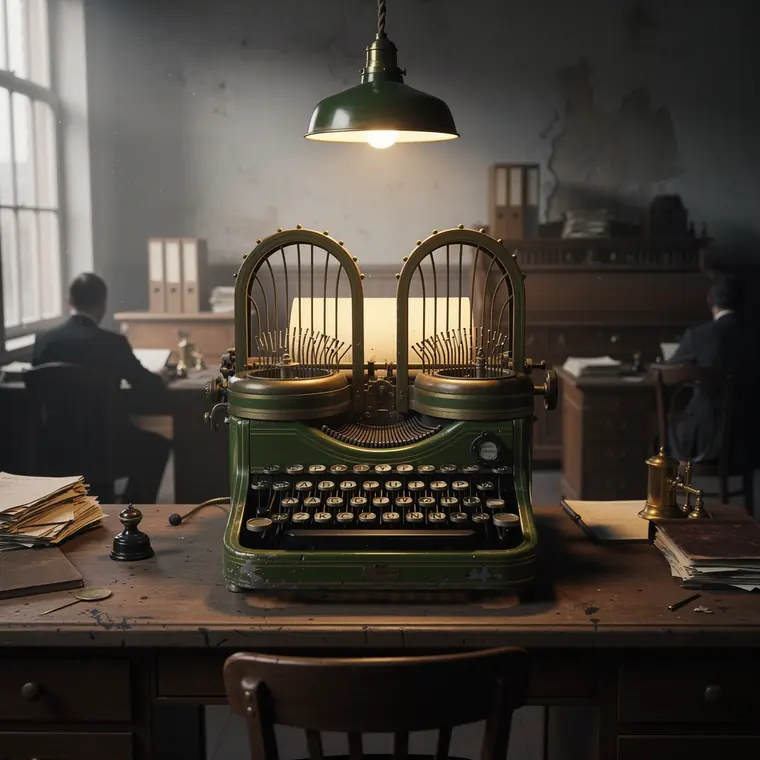
A green enamelled typewriter whose typebars stand in two tall inverted-U towers on either side of the platen, the bars arched up and over like the ribs of a bridge, striking downward onto the paper, the typed line fully visible between the towers, three curved rows of keys, each key cap bearing a single capital letter, the frame olive green with thin gilt striping, a plain sheet of paper in the platen, the machine on a flat desk beneath a tall window on the left, an electric bulb in a green shade hanging on a cord above the desk, a wooden vertical file and a roll-top desk behind, the office reaching into shadow with dark unlit figures at the distant desks.
- What it was used for
- The Oliver was an office typewriter with visible writing, recognisable by the two banks of type bars that hang above the platen on the right and left and strike down onto it. It was invented by Thomas Oliver, a Methodist minister working in Iowa in the 1880s; his first patent was awarded in 1891 and a second followed in 1894. The company was founded in Chicago in 1896 and manufacturing was at Woodstock, Illinois, some sixty miles to the north-west. Made in Chicago cites operating instructions for the No. 3 from about 1900; olive-green finish became standard with it and the base is thicker than on the No. 2. The machine was advertised on five qualities: simplicity, durability, speed, manifolding power and visible writing. In 1900 about three hundred people worked at Woodstock, and in 1903 the factory target was around one hundred machines per ten working hours.
- What was new
- The Oliver was not the first machine with visible writing: according to the 1923 commemorative history, the first type-bar visible writer, the Horton, appeared as early as 1883. What was new was its own route there. Remington struck upward against the platen and the writing lay hidden; Underwood struck from the front. Oliver's type bars hung in two banks at the sides and fell from above. That gives a hard, straight blow - good for carbon copies and stencils, which is why the firm advertised "manifolding power" - and three rows of keys were enough. The barb: the very downward blow that sold the machine fixed its shape: a fourth row of keys, once that had become the standard, would have needed even taller type-bar housings and still more weight. The middle of the 1920s was the end: a British businessman bought the company and its assets in 1927 for forty-five thousand pounds.
What the sources leave open: Little is documented about the No. 3 itself: Museo Nicolis dates it to 1900, Made in Chicago cites operating instructions of about 1900, and the plan's year of 1901 is not confirmed. Price and production figures for the model are missing; the figures given apply to the firm. On the end: Made in Chicago has the factory silent in 1926 and sold in 1927, The Antikey Chop gives 1928. Made in Chicago calls the Oliver "the first visible writer".