Underwood No. 5
1900 · Frontstrike · Work 527 of 1,871
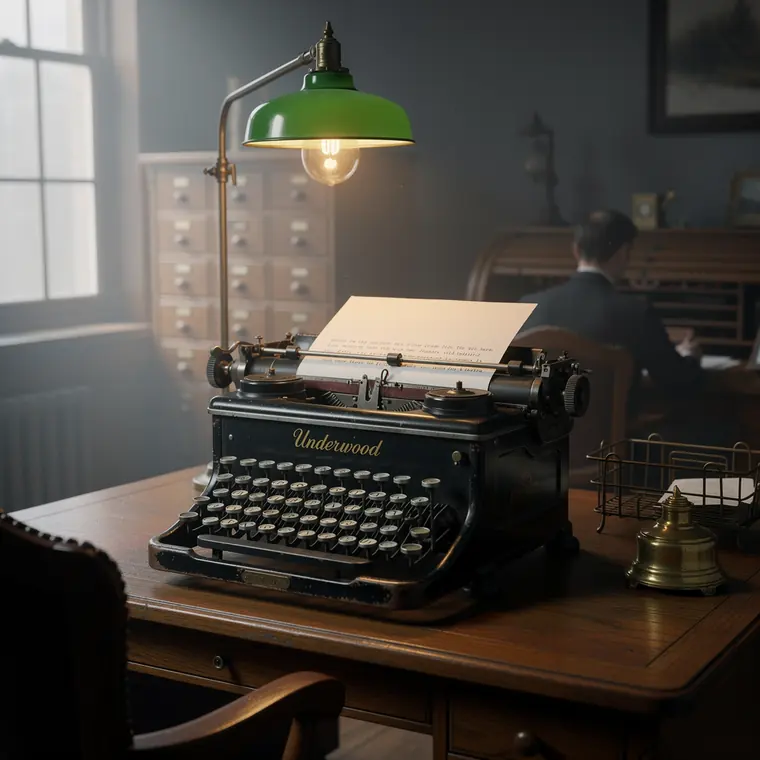
A standard office typewriter with open sides showing its typebar segment, the typed line visible at the point of striking, a ribbon spool on either side above the frame, four straight rows of round keys, each key cap bearing a single capital letter, three keys worn pale and smooth, a plain sheet of paper in the platen, the black frame with a gilt decal on the front of the type basket reading "Underwood", the machine on a flat oak desk near a tall window on the left, an electric bulb in a green glass shade on a bracket above, a wire letter tray and a brass inkwell beside it, a bank of wooden card-index drawers and a roll-top desk behind, the office running into grey depth with dark unlit figures at the far desks.
- What it was used for
- The Underwood No. 5 was the standard typewriter of the office in the first third of the twentieth century. It was designed by the German-American inventor Franz X. Wagner and built and sold by John T. Underwood's company. The type bars lie in front of the platen and strike it from the front at the level of the writing line - the typist sees what is appearing. The Science Museum Group gives the production period as 1900/1901 to 1931/1932 and states five million machines produced and sold; the design dominated the market for three decades, and by 1920 almost every typewriter imitated the Underwood. Manufacturing moved to Hartford, Connecticut, in 1901; by 1911 the works there stretched for blocks along Capitol Avenue.
- What was new
- The No. 5 was not the first machine with visible writing; on the Science Museum Group's account, though, its design set the standard for all manual typewriters that came after it. So what was new was not a component but a settlement: four banks of keys with a shift, type bars in front of the platen, a ribbon, the writing line in view - all in a form that could be built and repaired in quantity. After it almost every typewriter looked like this, until IBM brought the Selectric in 1961. The barb is in the names. The same Franz X. Wagner had designed the Caligraph around 1880 - seventy-two keys, an upward stroke, writing hidden, in other words the exact opposite. And the name on five million machines belongs not to the designer but to the salesman.
What the sources leave open: The five million is attributed differently: the Science Museum Group applies it to the No. 5, while Connecticut History says Underwood had produced over five million typewriters by the end of the 1930s - a company total. That Underwood had previously supplied ribbons to Remington and bought Wagner's patent when Remington began making its own ribbons is stated only by the Science Museum Group.