The Typing Pool
1920 · Clerical Labour · Work 528 of 1,871
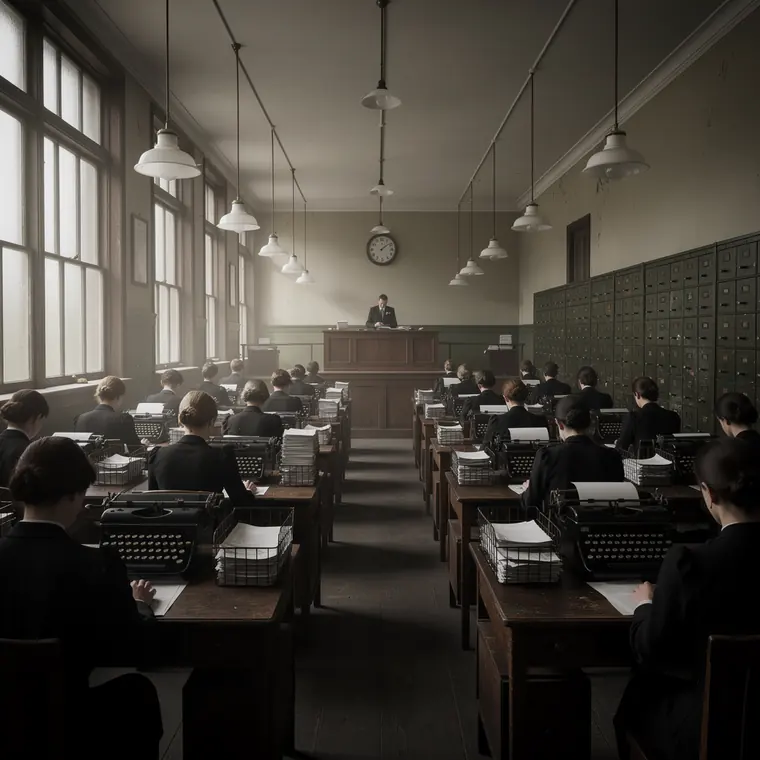
A long room of identical flat-topped desks in ranks, an identical typewriter at every place, each key cap bearing a single capital letter, a wire basket heaped with plain paper beside every machine, a supervisor's raised desk on a low platform facing the rows from the far end, a plain round wall clock above it, the typists seen from behind, hair pinned up, sleeves rolled, dark unlit figures at the far desks, tall windows along the left wall letting in a flat grey light, electric pendant lamps with white glass shades hanging in a line down the centre of the ceiling, steel filing cabinets against the right wall, the ranks of desks receding into the depth of the room.
- What it was used for
- The typing pool was a room in which women typists sat in rows at their machines and copied what was brought to them: dictation, shorthand notes, drafts. Whoever had composed the text sat elsewhere. The Heinz Nixdorf MuseumsForum describes the work there as monotonous, strenuous and noisy; often harmful to health, resulting in nervousness, dizziness, fatigue, inflamed tendons and impaired hearing; complaints of tremendous pressure of work, it says, can often be found in contemporary reports. The women mostly came from the middle class and increasingly from working-class families, because the post counted as a step up. In Germany the number of office workers almost doubled between 1907 and 1925, while the number of women among them rose fivefold. In the United States in 1920, on the Early Office Museum's figures, ninety-two per cent of stenographers and typists were women.
- What was new
- Nothing in this room was a new device. The typewriter, shorthand and dictation had existed for decades. What was new was the cut: writing was separated from the person responsible for the text and gathered into a department of its own. Only then could office work be divided up like factory work. The barb is the promotion that was not one. The HNF records that advancement out of the typing pool was rare; those who managed it became secretaries to a department head or a director. The work was badly paid; according to the HNF, young women office workers in the lower grades generally could not earn enough to set up a household of their own. Women also earned less than men: for Philadelphia in 1890 the Early Office Museum gives 925.70 dollars a year for male office workers and 433.12 dollars for female clerical workers; women as a whole there averaged 301.48 dollars.
What the sources leave open: The room is a type, not a single object; what is described is the 1920s typing pool as the HNF presents it in its permanent exhibition. The American percentages are attributed by the Early Office Museum to Kwolek-Folland (1994) and the wage figures to Bjelopera (2005); those books were not consulted. The wage figures are for 1890, not 1920. Figures for the number of typists in a pool, for piece rates or for workplace rules were not found.