The Cash Railway
1885 · Overhead Cash Carrier · Work 529 of 1,871
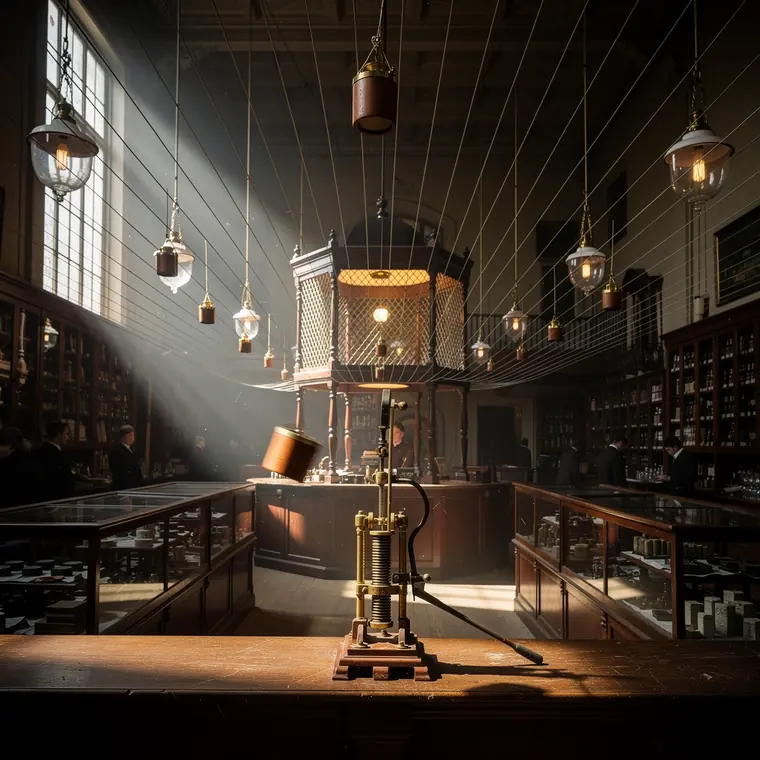
Taut wires strung across the ceiling of a department store sales floor, small wooden carriers with brass caps travelling along them, one carrier caught mid-flight, a spring catapult on a post at the counter end, a cashier's cage of turned wood and brass wire at the centre where all the wires converge, plain counters and glass cases below, a high window on the left throwing daylight across the wires, gas pendants with etched glass globes hanging along the ceiling, the store floor running back into shadow with dark unlit figures behind the far counters.
- What it was used for
- The cash railway was a wire or rail run that carried money through a department store. The assistant put the customer's note and the bill into a wooden cup or ball, released it, and the carrier travelled to the central cash desk, where a cashier made up the change and sent it back. William Stickney Lamson of Lowell, Massachusetts, patented a ball system in 1881 and in 1882 founded the Lamson Cash Carrier Company in Boston; later he licensed the wire-and-pulley construction patented by David Brown of Lebanon, New Jersey. The whole thing ran without outside power: either a ball ran down sloping rails of wood and leather, or a catapult spring launched a trolley along a taut wire. The Ephemera Society of America gives 3,725 systems installed through the London branch alone by 1889.
- What was new
- Sending things through a building was not new; pneumatic tubes were already carrying paper. Nor was the central cash desk new: according to the Harpenden local history society, Lamson's own shop already had one at the rear, and in company lore the money was wrapped in a handkerchief and thrown there. What was new was the mechanical route there and back. The assistant could wrap the goods while change and receipt were on their way. The barb is the running time. In 1974 some fifty such systems still existed around Britain. At Anscombe's in Harpenden seven wires converged on a central cash desk, one of them shooting the cup vertically down through a hole in the floor and then round a right angle; the system ran until 1982, when the shop closed, and was then divided among museums.
What the sources leave open: The figure of 3,725 comes from an article by the Ephemera Society of America that draws on company advertising; it was not checked against a second source. When the Anscombe's installation was put in is not known: the Harpenden local history society states expressly that no records survive for it. The plan's year of 1885 could not be tied to any event.