Hauptbahnhof Frankfurt
1888 · Iron Barrel Vaults · Work 53 of 1,871
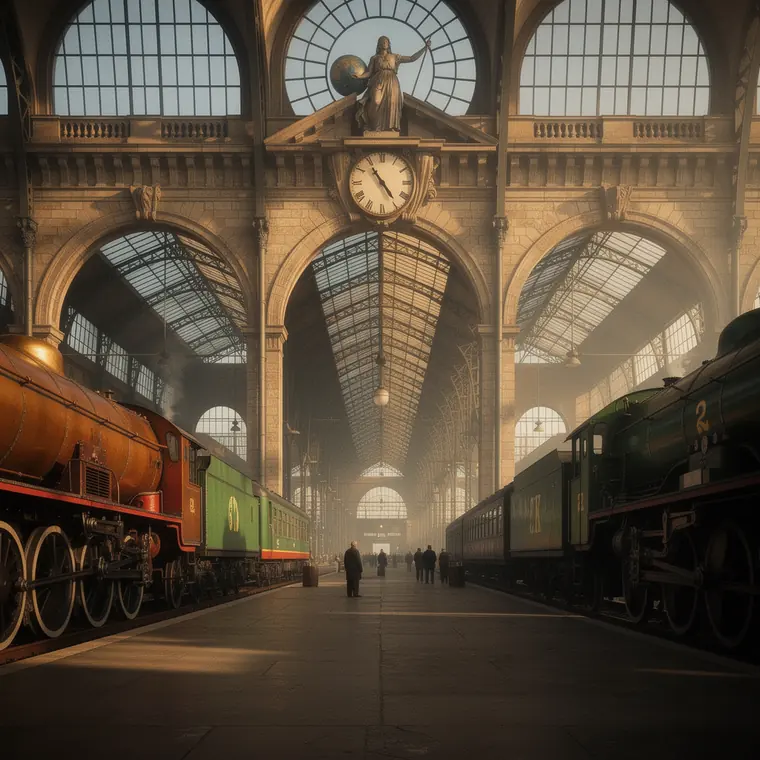
The Frankfurt Hauptbahnhof train halls, three parallel iron barrel vaults meeting the sandstone frontage, the figure of Atlas shouldering a globe above the central gable clock.
- What it was used for
- The Centralbahnhof replaced three separate termini belonging to three companies: the Taunus, Main-Neckar and Main-Weser stations. Built from 1883 by Philipp Holzmann, opened on 18 August 1888, with 18 platform tracks under three sheds set side by side, each spanning about 56 m, 186.40 m long and 28.60 m to the crown; the town facade measures 206 m. Until Leipzig Hauptbahnhof was completed in 1915 it counted as the largest station in Europe. Designed for 18 tracks, it was too small within a generation: from 1912 to 1924 two further sheds and six tracks were added. They followed Schwedler's structural principle but nearly halved the spans, and the crown height dropped to about 23 m.
- What was new
- The individual span was not the novelty. St Pancras had cleared some 73 m in 1868; Frankfurt reached about 56 m per shed (the structural literature gives 55.75 m). The novelty was the repetition: three identical three-hinged-arch sheds side by side forming one continuous triple-nave hall. Nor was the three-hinged arch itself new in 1888; a structural study traces Schwedler's series from the Berlin gasworks building (1863, 32.95 m) through Berlin Ostbahnhof (1866, 36.25 m) to Frankfurt. The gain was in area, not in span: 18 tracks under one roof, all on one level.
Further reading
- KulturRegion FrankfurtRheinMain: Frankfurt (Main) Hauptbahnhof (Maße, Erweiterung 1912-1924)
- ERIH - European Route of Industrial Heritage: Central Station Frankfurt
- Estévez Cimadevila / López César: The Palais des Machines of 1889. Historical-structural Reflections, VLC Arquitectura 2 (2015) - Spannweitenreihe Schwedler, Frankfurt 55,75 m
- Historical Marker Database: Wortlaut der Gedenktafel am Hauptbahnhof Frankfurt
- Stadt Frankfurt am Main: Chronik des Bahnhofs- und Gutleutviertels