The Autographic Register
1900 · Carbon Duplicate Forms · Work 530 of 1,871
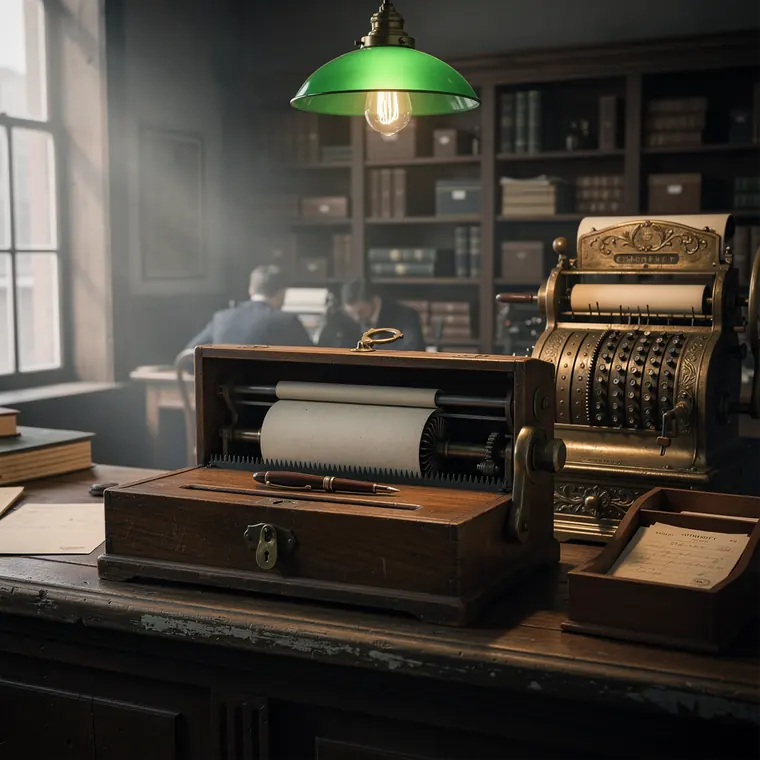
A counter-top box of varnished wood holding two continuous paper rolls with a carbon sheet between them, a hinged writing plate laid over the top, a sheet of plain paper drawn across it, one copy tearing off along a serrated edge for the customer while the other winds onto a locked spool inside, a small brass lock on the side, a pen resting in the groove of the plate, the box on a shop counter near a window on the left, an electric bulb in a green shade above, a cash register and a letter tray beside it, the counter and shelving running back into the dim depth of the room.
- What it was used for
- The autographic register was a box that stood on a shop counter or a desk. Inside it several paper rolls lie one above the other with carbon paper between them. The clerk writes the order once on the topmost strip; the copies make themselves. A crank advances the paper, one strip is torn off and handed to the customer, and a second stays in the locked box for the proprietor. James Conwell Shoup of New York filed such a device for patent on 14 May 1887 under the name "Autographic Register"; it was granted on 31 October 1893 as US 507,760. The specification describes a hinged casing, a window for reading the stored strip and crank gearing; the ten numbered claims claim combinations of gripping rolls, tablets in front of and behind the rolls, dispensing rolls, record-strip storage and puncturing points.
- What was new
- The copy was not new; carbon paper and the letter press had long existed. Registration, which makes pre-printed forms line up line on line, came only later: the Standard Register Company's history names slipping layers as the main drawback of Shoup's register and credits the remedy to Schirmer, who applied chain and sprocket to the register and so allowed all the layers to be pre-printed. What was new was rather what the box locks away. The barb: the device not only saved copying work, it also kept an eye on one's own staff - and the evidence was the clerk's own handwriting, hence "autographic". One layer he writes himself and cannot reach. The National Cash Register Company sold the same thing: its 1898 catalogue lists such registers at ten to forty dollars, with rolls of about seven hundred slips, and on the summary models the locked-in strip shows the consecutive number, the clerk's initials and the amount.
What the sources leave open: The patent dates are from the granted specification itself. The company history credits Shoup with the autographic register as early as 1883, four years before his filing; whether an earlier device is meant remains open. The same account calls Schirmer Theodore in one place and Thomas in another, so only the surname is used here. The prices of ten to forty dollars come from a reproduction of the 1898 NCR catalogue on a collectors' site, not from the original.