National Cash Register Model 5
1892 · Cash Register · Work 531 of 1,871
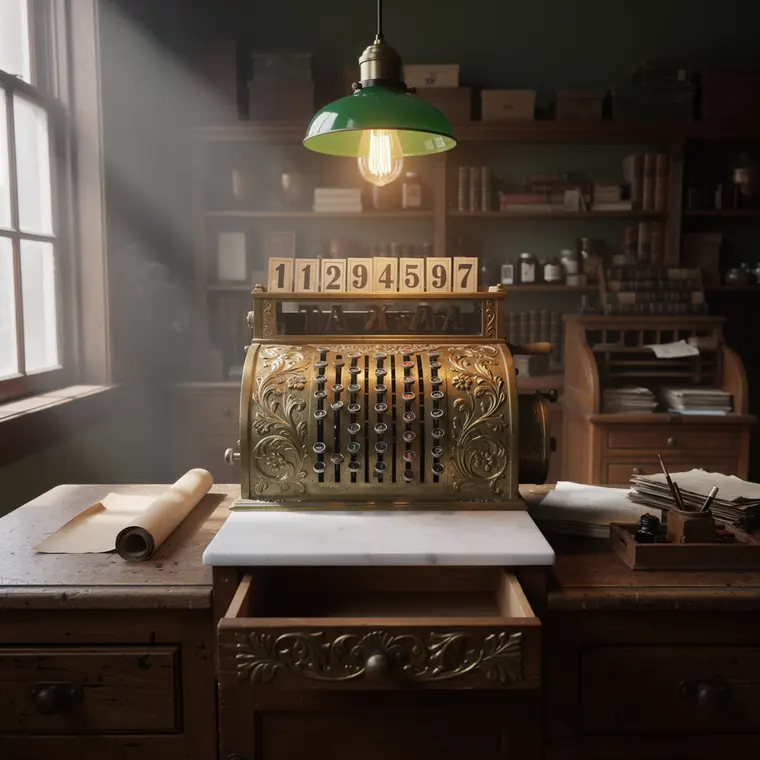
An ornate cast brass cash register with scrolled foliage across its whole case, a marble ledge along the front, numeral flags standing up behind a glass window at the top, a bank of round keys in columns across the front, the cash drawer standing open and empty, its wooden compartments plain, the register on a wooden shop counter, a tall window on the left throwing hard light across the brass, an electric bulb in a green glass shade hanging above, a plain roll of wrapping paper and a pen tray on the counter, shelving and a roll-top desk further back, the room fading into grey depth.
- What it was used for
- The cash register stood on the shop counter and did several things at a keystroke: it showed the amount on pop-up indicators and opened the cash drawer. The Smithsonian National Museum of American History states the reason plainly: it had been all too easy for clerks and barkeepers to keep part of the money they received. On the classification used by the collectors' site brassregisters.com, the Model 5 belongs to the group of "detail adders": behind the keyboard stand rows of counter wheels, one for each amount, and every keystroke advances the corresponding wheel by one. The maker was the National Cash Register Company of Dayton, Ohio, which John H. Patterson had taken over for 6,500 dollars in 1884 and renamed. In 1886 it sold barely a thousand registers; in 1892, fifteen thousand.
- What was new
- It was not the first cash register. The Ritty brothers of Dayton had invented the first, which James Ritty patented in 1879, and the firm that sold the Model 5 was built on their patents. The detail adders held on to the individual sales: in the evening the proprietor could read off how many sales had been rung at each amount. What the machine could not do was add, although according to the Smithsonian the Rittys' first machine had already tallied total receipts in a locked compartment. At NCR that came only with the later total adders, models 30, 31 and 33, which summed every amount into a single dollars-and-cents counter. That is the barb: a machine bought because the staff were not trusted left the arithmetic with the owner - he added up the wheels by hand every evening and reset them. And the firm's real innovation was not mechanical: in 1892 Patterson made a selling tour of fifty cities in fifty-one days.
What the sources leave open: Thin. No museum, maker or archive record for a "Model 5" dated 1892 was found. The assignment to the detail adders rests solely on the classification used by a collectors' site, which places models 0, 1, 2 to 14, 17, 29 and others in that group without giving years. The figures of 1,000 and 15,000 apply to the company, not the model. Price, number of keys and construction are not documented.