The Time Recorder
1894 · Workman's Time Recorder · Work 532 of 1,871
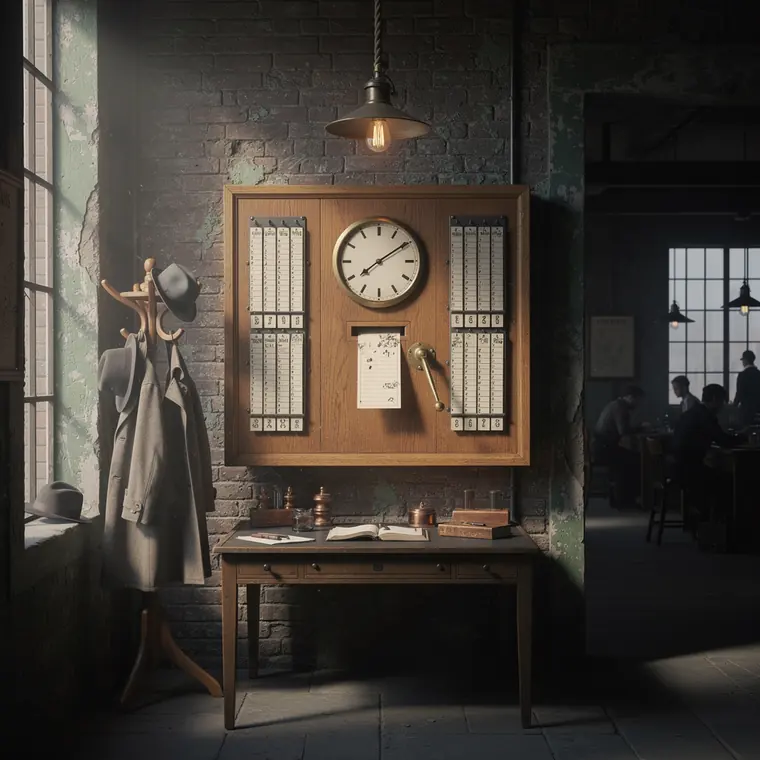
An oak case mounted on a brick factory wall with a plain round clock face above and a narrow card slot beneath, a rack of cards in numbered pockets on either side, one card half inserted in the slot, a card ruled into columns with small stamped smudges of ink down the rows, a brass lever on the side of the case, a high window on the left letting cold daylight across the oak, an electric bulb in a tin shade hanging on a cord above, a coat rack and a plain timekeeper's desk beside the wall, the passage continuing into shadow with dark unlit figures moving at its far end.
- What it was used for
- The time recorder was the clock at the works gate: a mechanism that printed each worker's arrival and departure instead of a timekeeper writing them down. Willard Bundy states the purpose in his own specification, filed in 1887 and granted in 1888 - to compel employees to make the entry and to save the expense of watchmen or timekeepers. The Wisconsin Historical Society records a Dey Time Recorder in use at the Appleton Woolen Mills from roughly 1894: employees moved a pointer to their number and pressed its peg into the guide hole, and the time was printed beside their name on a roll of paper inside the case. At the Otis mill in Jay, Maine, around 1910 a worker pushed a card bearing his printed name into a slot and pressed a lever; at week's end the payroll clerk computed hours and pay from those cards.
- What was new
- What was new in 1894 was not the clock but the card. IBM's own corporate history names three driving inventions: the Bundy Key Recorder (1888), the Dial Recorder (1888) and the Rochester Recorder patented in 1894 by Daniel M. Cooper, which IBM calls the first card-based system for recording attendance. The difference is physical: before, the entry went onto a tape or sheet inside the case; after, every worker had his own card, and the payroll clerk worked from those cards. Cooper was not alone. Alexander Dey of Glasgow patented the dial recorder in 1888, Frank Brook built his first apparatus in 1889, and in 1894 Edward G. Watkins founded the Simplex Time Recorder Company around his button recorder - the firm IBM later handed the business to: by 1958 the Time Equipment Division accounted for less than 3 per cent of gross revenue and was sold to Simplex.
What the sources leave open: Cooper's patent number could not be found; IBM gives only the year. No sales or installation figure could be verified for any maker. One collectors' site (workclocks.co.uk) cites, from a photograph, 10 December 1878 as possibly Bundy's first patent date; the specification (filed 1887, granted 1888) and IBM are followed here. The Wisconsin Historical Society itself says "roughly 1894".
Further reading
- IBM, International Time Recording (Firmengeschichte)
- Wisconsin Historical Society, Dey Time Recorder, Appleton Woolen Mills
- Maine Memory Network / Maine's Paper & Heritage Museum, ITR time clock, Otis mill, Jay
- US-Patent 393.205, Willard L. Bundy, Time-Recorder (angemeldet 1887, erteilt 1888)
- Bundy Mfg. Co. v. Columbian Time-Recorder Co., 64 Fed. Rep. 851 (2d Cir., 3. Dezember 1894)
- Workclocks, Time recorder timeline (Sammlerseite)