The Stopwatch
1899 · Time and Motion Study · Work 533 of 1,871
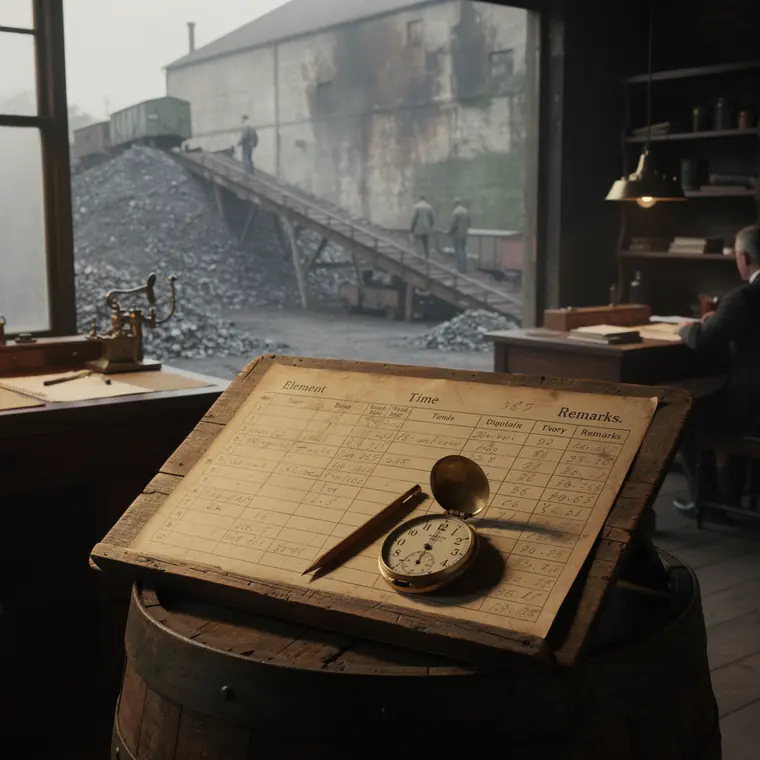
A mill yard with a pile of pig iron and a wooden loading ramp, in the foreground a wooden observation board propped on a barrel, on the board a timing sheet ruled into columns for the elements of a single task, pencil marks part filling the columns, a stopwatch lying face up on the board with its brass case open, a pencil beside it, hard daylight from the left across the iron, rail wagons and the mill wall behind, dark unlit figures of labourers at the far end of the ramp.
- What it was used for
- The time-study stopwatch was the instrument by which piece-work prices were fixed. In Shop Management, Frederick Winslow Taylor writes that in 1883, as foreman of the machine shop of the Midvale Steel Company, it occurred to him to time each element of a job separately and add the part times, rather than search old time records and guess at the price; he then set up a time-study and rate-fixing department. Two objects must be kept apart. Sanford E. Thompson's "watch book" concealed one to three watches in its cover, worked by the fingers of the left hand without the knowledge of the man observed. Taylor's own board carried the watch visible through a flap cut in the observation sheet - there, he writes, all attempt at secrecy is abandoned.
- What was new
- What was new was not the movement but the dial. The decimal-minute stopwatch of time study has a small dial in whole minutes and a large dial in hundredths of a minute, as the learned society IISE defines it in the glossary of standard ANSI Z94.17. Taylor says why in Shop Management - the watch should have a decimal dial to save clerical work. The innovation was arithmetical: it removed the conversion step before the figures could be added into a piece rate. The barb is in the statute book. The Army appropriation act of 4 March 1915 forbade paying, out of those funds, the salary of any officer or other person in charge of an employee's work while making a time study of any job with a stop watch or other time-measuring device, and in its second limb forbade premiums and bonuses too.
What the sources leave open: The year 1899 does not come from Taylor: it does not occur in The Principles of Scientific Management. Charles D. Wrege and Richard M. Hodgetts carry it in the title of their 2000 article and hold Taylor's pig-iron account to be erroneous; Jill R. Hough and Margaret A. White concede the discrepancies in 2001 and defend the story as deliberate persuasion. No year of repeal for the 1915 ban could be verified.
Further reading
- F. W. Taylor, Shop Management (Harper & Brothers), Volltext
- F. W. Taylor, The Principles of Scientific Management, Volltext
- IISE, Glossar der Norm ANSI Z94.17 Work Design and Measurement (Decimal-Minute Stopwatch)
- Heeresbudgetgesetz vom 4. März 1915, 63. Kongress Sess. III Kap. 143, 38 Stat. 1083
- Wrege/Hodgetts, Frederick W. Taylor's 1899 Pig Iron Observations, Academy of Management Journal 43 (2000)
- Hough/White, Using stories to create change: the object lesson of Frederick Taylor's pig-tale, Journal of Management 27 (2001)