Elliott-Fisher Flat Writing Machine
1903 · Flat-Bed Book Typewriter · Work 534 of 1,871
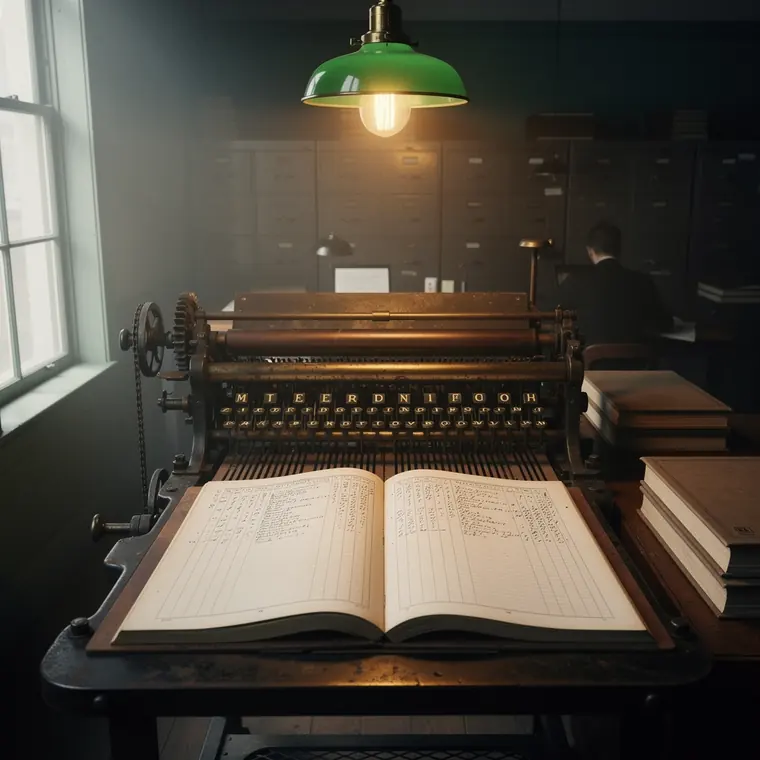
A typewriter carriage riding on a wide flat cast-iron bed, a bound ledger lying open on the bed, the whole typing mechanism travelling across the double page on rails while the book stays still, entries typed straight into the ruled columns of the book, each key cap bearing a single capital letter, a chain and pulley at the side to draw the carriage across, the bed on a heavy steel-framed table beside a tall window on the left, an electric bulb in a green glass shade hanging above, plain ledgers stacked beside the table, steel filing cabinets and flat desks receding into the dim room with dark unlit figures at the far desks.
- What it was used for
- The Elliott-Fisher was a typewriter with a flat bed: the bound book lay open beneath it and the writing mechanism, keyboard and all, travelled across it. The paper did not move throughout the entire typing operation, as the trade reference The American Digest of Business Machines (1924) puts it; on the predecessor Elliott & Hatch, according to Mares (1909), a thumb-screw device at the back set the machine's height to the thickness of the book. The point was the bookkeeping room: because the bed was flat, several related forms of different sizes could lie under it and be posted in one writing - most usually ledger, statement and proof sheet at one time. The Digest also names the book writing machine for recording deeds and other public documents. The registers added and subtracted in up to 29 columns.
- What was new
- A contemporary, Geo. Carl Mares, names the inversion in one sentence in The History of the Typewriter (London 1909, p. 165): "The great line of demarcation was in providing for a stationary platen and a moveable machine, instead of a moveable platen and a stationary machine." A machine with a cylindrical platen had to feed the sheet around the cylinder and so could write neither in a bound book nor on stiff card. The firm was not first: Charles B. Whitaker filed in 1894 for a machine for printing or writing in books (granted 1895), and in 1923 the trade journal Typewriter Topics compared the Ktypograph of Xavier Progin (spelled "Projean" there), printer of Marseilles, 1833 - in which the type mechanism moved rather than the paper - with the Elliott-Fisher flat machines. 1903 is not a model year but the month of a consolidation: in March 1903 the Fisher Book Typewriter Company combined with the Elliott-Hatch Book Typewriter Company; the adding attachment had been a feature since 1902. In 1927 Underwood, whose No. 5 had, per the Hagley finding aid, outsold all its competitors combined for two decades, merged with Elliott-Fisher as Underwood Elliott Fisher.
What the sources leave open: No source was found for an "Arthur W. Elliott"; the trade sources name only "Elliott" and W. P. Hatch, and a firm patent (filed 1899, granted 1901) names Frederic W. Hillard as inventor, so no first name is given here. The user count in a 1923 advertisement is illegible in the scan; only "more than 400 different lines of business" is verifiable. On the merger year, a collectors' page gives 1926, the Hagley finding aid 1927.
Further reading
- Typewriter Topics, Historical Number, Oktober 1923 (Elliott-Fisher, S. 59 und 61)
- John H. McCarthy (Hrsg.), The American Digest of Business Machines, 1924
- Geo. Carl Mares, The History of the Typewriter, London 1909, S. 165-166 (Scan-Seite 173)
- US-Patent 685.762, Frederic W. Hillard, Elliott & Hatch Book Typewriter Co. (1899/1901)
- Hagley Museum and Library, Findbuch Typewriter trade cards (Acc. 1996-225)
- US-Patent 535.607, Charles B. Whitaker, Type-writing machine (angemeldet 1894, erteilt 1895)