The Time Clock at Seven
1910 · Clerical Labour · Work 535 of 1,871
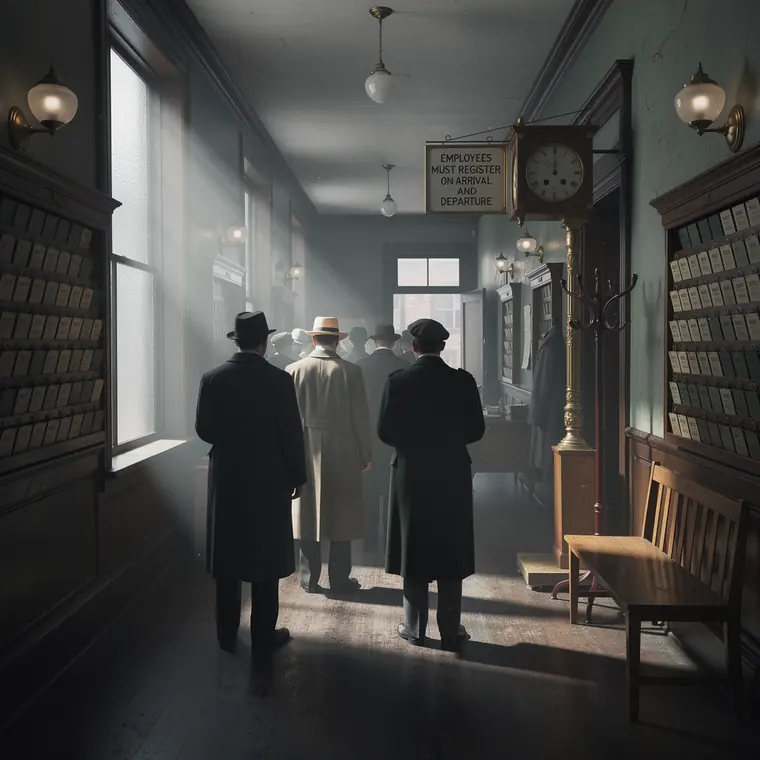
A queue at a wall-mounted time recorder in a corridor before the working day, an oak case with a plain clock face, a rack of cards emptying on the left and filling on the right, a plain framed notice above the clock, coats still buttoned, hats on, the queue seen from behind, dark unlit figures further down the corridor, a window at the corridor end on the left throwing a long band of daylight across the floor, electric bulbs in white glass shades along the ceiling, a coat rack and a plain bench along the wall, the corridor running into the depth of the building.
- What it was used for
- This work shows no invented moment but a documented arrangement: the time clock and its card rack, where the shift began. At the Otis mill in Jay, Maine, a clock by the International Time Recording Company stood in about 1910. The worker pushed a card bearing his printed name into the slot, pressed the lever, drew the card out with the time printed on it - on arriving and on leaving; at week's end the payroll clerk computed hours and pay from the cards. Gledhill-Brook built the distinction into the case: an "In and Out Time Clock" by that firm in the Science Museum Group collection has a card slot on a shelf and, on the front, an "in/out" switch with the operating lever. Seven o'clock was not custom but law: the British Factory and Workshop Act 1901 allowed textile factories only two starting times, six to six or seven to seven - though the Act governed the hours of women, young persons and children, not those of adult men.
- What was new
- The machine was meant not only to record the time but to classify the man at the moment of clocking. Patent US 831,790, by Clara Kyser and Scott McGowan (filed 2 January 1906, granted 25 September 1906, assigned to the Crawford-McGregor & Canby Co.), describes a shifter for a two-coloured printing ribbon: "regular" workmen were to have their times printed in one colour, for example blue, and "irregular" workmen in another, for example red, so that the two classes could readily be distinguished by the colour on their cards. The barb is the quarter of an hour. Rounding starting and stopping time to the nearest 5 minutes, tenth or quarter of an hour is still accepted by the United States regulation 29 CFR 785.48(b), provided employees are not undercompensated over time; the regulation itself describes the practice as having existed "for many years". The clocks are gone; the rounding is in the Code of Federal Regulations.
What the sources leave open: No pay docked for lateness could be verified for 1910; the nearest dated example is a punch card of 10 November 1943 in the Museum of Technology (Spalding, Lincolnshire); per the museum, 15 minutes would have been docked for each late day. That red print denoted lateness is not documented - the patent speaks of regular and irregular workmen. Closed works gates are not documented, and the circulating "Victorian mill rules" are a 2002 souvenir.
Further reading
- Maine Memory Network / Maine's Paper & Heritage Museum, ITR time clock, Otis mill, Jay
- Science Museum Group, In and Out Time Clock, Gledhill-Brook (Objekt Y1976.32)
- US-Patent 831.790, Kyser und McGowan, Printing-ribbon shifter for workmen time-clocks
- Factory and Workshop Act 1901, s. 24 und s. 26 (annotierte Ausgabe 1901)
- 29 CFR 785.48(b), Use of time clocks (Cornell Legal Information Institute)
- Museum of Technology, The History of Gadgets and Gizmos (Spalding), Works clocking machine & card rack, 1950er (Objekt 257)