Burroughs Class 3 Bookkeeping Machine
1911 · Bookkeeping Machine · Work 536 of 1,871
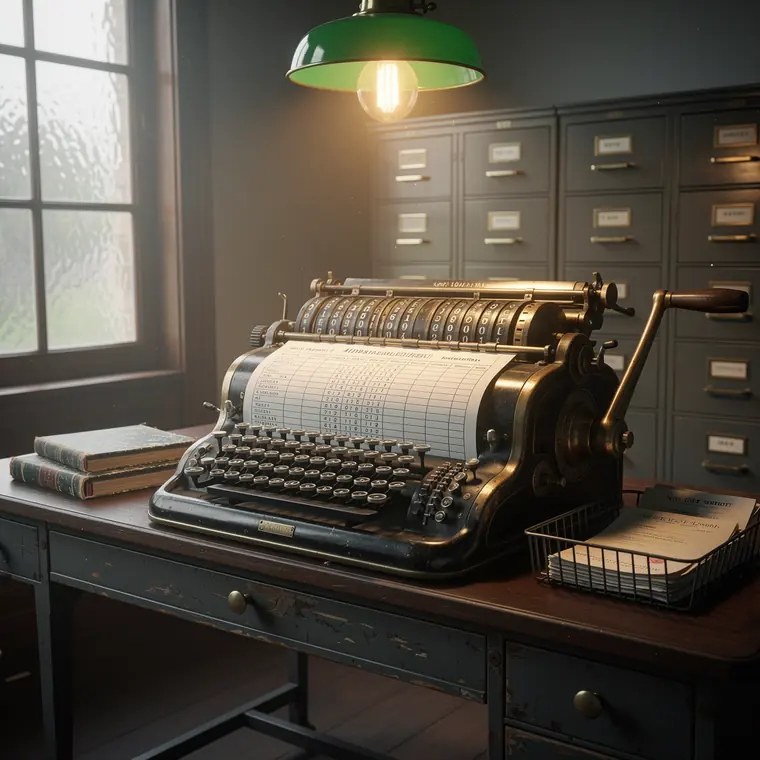
A wide machine combining a typewriter keyboard with an adding mechanism, the keyboard in front, each key cap bearing a single capital letter, a bank of round numeral keys beside it in columns, a long statement form ruled into columns carried across its wide platen, several totalling registers ranged in a row along the back with small windows, a heavy return lever at the right side, the machine on a steel-framed desk beside a tall window on the left, an electric bulb in a green glass shade hanging above, plain ledgers and a wire tray beside it, steel filing cabinets and flat desks running back into the dim office with dark unlit figures at the far desks.
- What it was used for
- By the maker's own classification the Burroughs Class 3 was not a bookkeeping machine but the firm's ordinary adding and listing machine: "single counter, low keyboard, visible printing", and, per The American Digest of Business Machines (1924), the standard models of the Burroughs line, sold for all ordinary commercial work. At Burroughs the bookkeeping machine was Class 6: high keyboard, blind printing, adding, listing and directly subtracting, with its own columns of folio keys and of character keys that printed the nature of the posted item beside the amount. It was used for posting ledger and statement and in bank accounting. How well Burroughs adding machines sold is shown by a note of January 1911, which names no class: the Continental and Commercial National Bank, Chicago, ordered 100 machines, mostly electric, bringing it to 165 Burroughs adding and listing machines - "said to be the largest number of adding machines used in any one bank in the world", as the trade journal puts it.
- What was new
- What was new was visibility - for Burroughs. On the blind-printing models - the early types and Classes 1, 2 and 6 - the carriage sat at the rear, and, per the 1924 Digest, items and totals were not visible as they were printed; the carriage was hinged at the bottom and had to be swung away from the printing point to inspect the work. On the Class 3, per a Burroughs advertisement of 1912, the paper carriage stood only three inches behind the keyboard, and writing, adding and printing could all be seen at the same distance from the eye. Burroughs did not invent the machine but bought it: the Digest traces it to the Pike Adding Machine Company of Orange, New Jersey, taken over by Burroughs in 1909, and records the transfer of the tools and dies; the Smithsonian notes of its 1915 example that the machine is very similar to the Pike. In its own advertisement of July 1912 Burroughs wrote that the Class 300 line was designed by the firm's own inventors and built in the Burroughs factory.
What the sources leave open: No primary source opened here gives 1911 as the year of introduction. The trade press announces the new "Pike Visible" in January 1910 and still runs the heading "High Desk Visible Burroughs - Pike" in May 1911; 1911 is given by collection catalogues. No production or sales figure for 1911 could be found. The title "Bookkeeping Machine" does not match the maker's classification, in which the bookkeeping machine is Class 6.
Further reading
- John H. McCarthy (Hrsg.), The American Digest of Business Machines, 1924 (S. 29, 33, 466, 523, 533)
- Office Appliances, Januar 1911, Bd. 13 Nr. 2 (Burroughs Make Big Sale)
- Office Appliances, Juli 1912, Bd. 16 Nr. 2 (Burroughs-Anzeige Class 300)
- Smithsonian NMAH, Burroughs Class 3 adding machine (1915, Objekt 690654)
- Early Office Museum, Calculating Machines: Adding/Listing (Class 3, Preise 1915)
- Office Appliances, Januar 1910, Bd. 11 Nr. 2 (The new Pike Visible adding machine, S. 109)
- Office Appliances, Mai 1911, Bd. 13 Nr. 6 (High Desk Visible Burroughs - Pike)