The Letter Press
1870 · Copying Press · Work 537 of 1,871
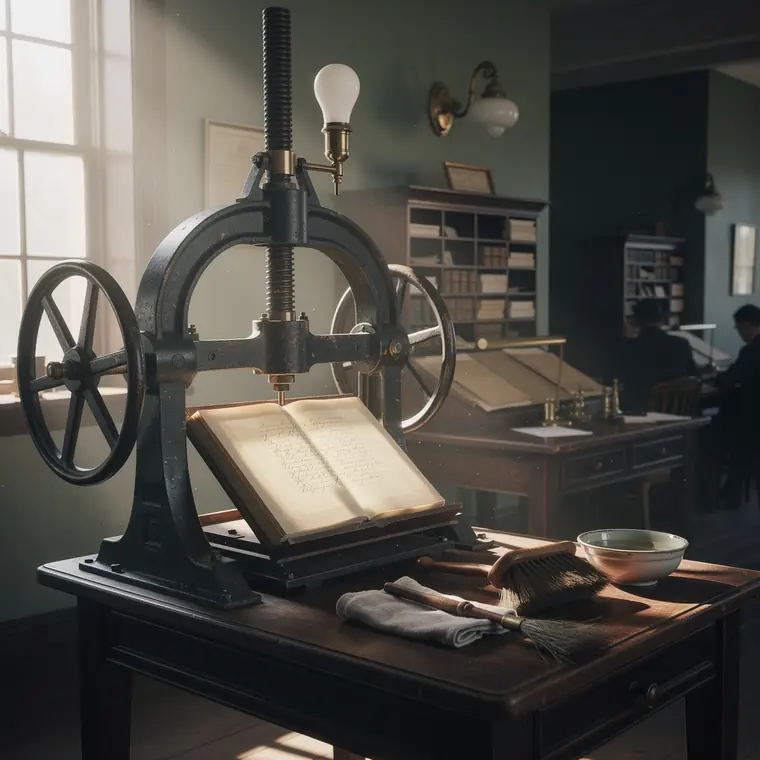
A cast-iron screw press with a heavy wheel handle on a side table, a bound copying book of thin tissue leaves open beneath its plate, a damp cloth and a broad brush lying beside it, a bowl of water, one tissue page showing the faint mirrored ghost of a handwritten letter, the table beside a tall window on the left so the light passes through the tissue, a gas bracket with a frosted globe on the wall, a slant-top clerk's desk and a pigeonhole cabinet behind, brass inkwells and plain ledgers on the desks, the counting room fading into shadow with dark unlit figures at the far desks.
- What it was used for
- The copying press was the counting house's memory. The letter was written in copying ink, a dampened tissue leaf of the bound copybook laid on it, book and press screwed shut - and part of the ink migrated into the tissue in mirror image, to be read through the thin leaf from its front. In his 1852 prize essay on inventions applied to practical banking, Granville Sharp writes that since the adoption of penny postage the letter department in banks had much increased and the copying of letters had become a daily labour. How long it lasted is shown by the evidence JoAnne Yates examines in Control through Communication (1989): the Illinois Central Railroad copied outgoing letters into press books at least from the late 1850s to 1896, and the Scoville Manufacturing Co. was still doing so in 1913. Screw presses were still marketed in 1950, and W. B. Proudfoot reports in 1972 that an organisation in London was still keeping press books in the late 1950s.
- What was new
- What was new was not the copy - clerks had transcribed letters for centuries - but that the copy consisted of the original's own ink. No second hand, and so no second person's error, stood between the record and the letter. Sharp names the consequence in the same breath in 1852: because the presses made it so easy, the least troublesome and safest way was to copy everything; earlier, when letters had to be transcribed by hand, some solicitors and commercial firms had as a rule not copied their letters at all. The price appears in Sharp a few pages earlier, under the heading "Ink": letters, he writes, are by the copying machine process robbed of half the ink put upon them. The machine bought to secure the house's memory damaged the document that left the house. And Sharp sets his own comparison beside it: a deed in his possession 506 years old shows barely any deterioration in colour, while modern ink from a respectable maker looks markedly less black after six years.
What the sources leave open: None of the sources opened gives a British patent number for Watt's 1780 copying press, so none is printed here. Three sentences about dampening the paper that circulate as Sharp's do not appear in the 1852 edition read here and have been left out. No contemporary complaint specifically about illegible press copies could be found; the documented complaints concern ink loss, retrieval and time.
Further reading
- Granville Sharp, The Prize Essay on the Application of Recent Inventions ... to Practical Banking, 1852
- Early Office Museum, Antique Copying Machines (mit Belegen aus JoAnne Yates, Control through Communication)
- J. William Schulze, The American Office, 1913, S. 45 (Copying Machines)
- Library of Birmingham, Archives and Collections, James Watt's Copying-Press (Quellenblatt)
- US-Patent 117.314, Charles McIlvaine, Improvement in Copying Inks, 1871