Edison's Electric Pen
1876 · Stencil Duplication · Work 538 of 1,871
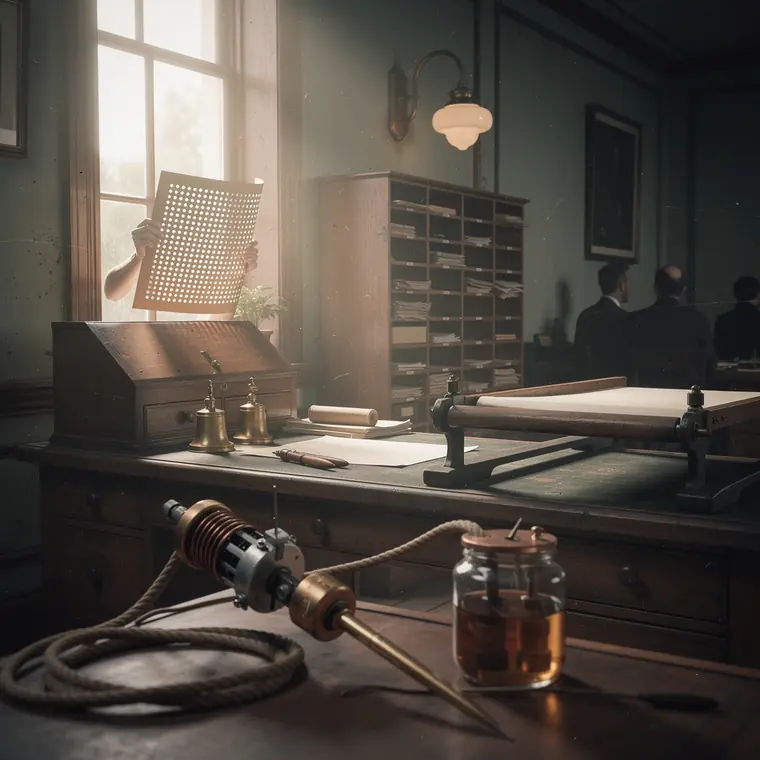
A stylus with a small electric motor mounted at its upper end, the motor a compact coil and armature driving a fine needle up and down, a wet cell battery in a glass jar on the desk with two cloth-covered wires running to the pen, a perforated stencil sheet held up to the window so light shows through the pinholes, a flat-bed frame with a roller beside it, the desk beneath a tall window on the left, a gas bracket with a frosted globe on the wall, a slant-top desk and a pigeonhole cabinet behind, brass inkwells and plain papers on the desks, the room running into shadow with dark unlit figures at the far desks.
- What it was used for
- The electric pen was a duplicator. In a hand-held stock a small electric motor drove a needle up and down, perforating the sheet into a stencil as one wrote; ink was then rolled through the holes in a flatbed press. The advertisement placed by the manager, Charles Batchelor, in The Publishers' Weekly in July 1876 names the uses and the price: letters, circulars, price-lists, market quotations, briefs, contracts, maps, architectural drawings - $35, sent C.O.D. In its 1884 catalogue Western Electric wrote that the apparatus was especially adapted to the needs of railway and telegraph companies. JoAnne Yates traced its use in the offices of the Illinois Central Railroad: from 1876 it served for notices to be seen only by employees, and later took on the narrower job of filling the blanks in printed forms - station name, effective date, names of the old and new agents.
- What was new
- What the pen could do that nothing before it could: make a printing stencil by hand at writing speed. Patent US 180,857 (filed 13 March 1876, granted 8 August 1876) says so itself - perforated patterns were known from embroidery and fresco work, but they were not adapted to writing, because the colour used was not permanent and no means had been devised for writing or drawing by hand with sufficient rapidity. On top of that it was an electrical appliance in an office years before the first central power systems - and that held back sales. The Western Electric manual turned the clerk into a chemist: dissolve bichromate of potash in water, add sulphuric acid, wash the zincs after a while and re-amalgamate them with quicksilver, renew the fluid every one to two weeks, and always recharge the battery at a sink with water running. His claim did not go unchallenged: in 1877 he had to defend it in two interference cases, against Henry Trueman and against Edward Stewart, and won both. The last royalty statement he received from Western Electric, in 1894, was for $6.63.
What the sources leave open: The much-quoted 60,000 pens are not a sales figure: the sentence comes from Sarah K. Bolton's How Success is Won (1885) and says "over sixty thousand now in use"; the royalty statements in the Edison Papers account, on FTL Design's analysis, for fewer than 4,000 sales. FTL Design gives the needle rate, after the manual, as 50 punctures per second; a figure of about 135 appears in none of the sources listed. The much-cited "15 copies a minute" was found nowhere.
Further reading
- US-Patent 180.857, Thomas A. Edison, Improvement in Autographic Printing (1876)
- The Publishers' Weekly, 1. Juli 1876 (Anzeige Edison's Electrical Pen, Charles Batchelor)
- FTL Design, electricpen.org: Chronologie, Preislisten, Handbuch von Western Electric
- Western Electric, Directions for the Setting up and Using of Edison's Electric Pen (Abschrift)
- Early Office Museum, Antique Copying Machines (Edison Electric Pen, Yates zum Illinois Central)
- Sarah K. Bolton, How Success is Won (Lothrop), S. 189-190
- FTL Design, electricpen.org: Preislisten (Western Electric Katalog 1884, S. 54-55)