Gare d'Orsay
1900 · Iron Hall with Coffered Vault · Work 54 of 1,871
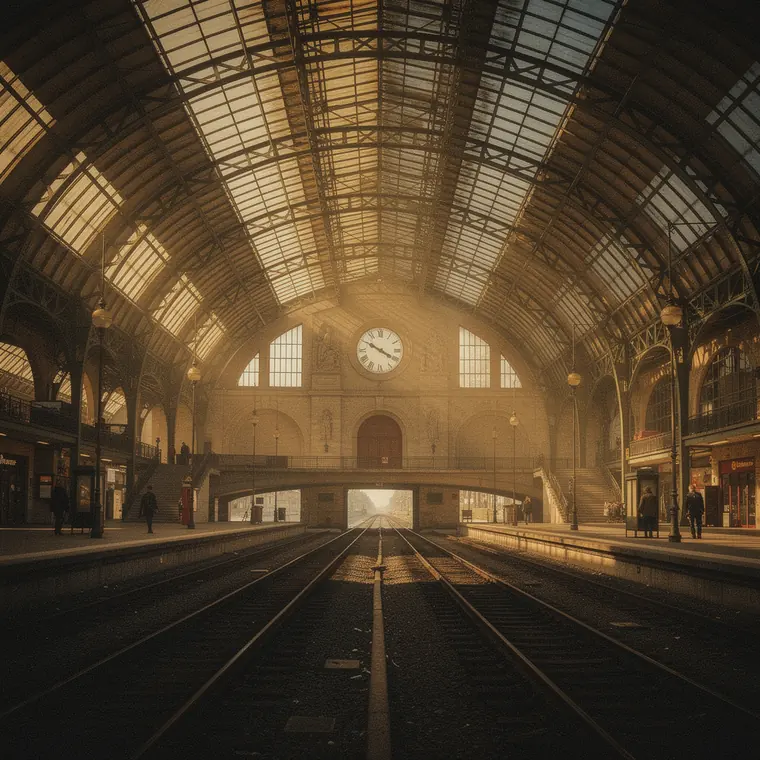
The Gare d'Orsay on the Seine quay, its coffered glazed barrel vault running the length of the platforms, twin station clocks set into the stone end wall.
- What it was used for
- Station of the Paris-Orléans railway, built from 1898 by Victor Laloux and opened on 14 July 1900 for the World's Fair. It extended the line from the Austerlitz terminus through a tunnel along the Seine into the city centre. The hall measures 138 m long, 40 m wide and 32 m high; it contains some 12,000 tons of steel - more than the 7,300 tons of iron the operator gives for the Eiffel Tower. A hotel with 370 rooms occupied the same building. The platforms were too short for the lengthening express trains: on 2 November 1939 long-distance service ended there, after 39 years. Then a suburban station, a parcel depot, in 1945 a reception centre for returning prisoners of war, a film set, a demolition candidate; listed as a monument historique in 1978, a museum since December 1986.
- What was new
- Steam was impossible in the tunnel along the Seine embankment. The line was therefore planned from the outset for electric traction, direct current on a third rail, with a fixed overhead conductor rail inside the station. Whether Orsay was the first fully electrically worked terminus remains open: the French railway historian Clive Lamming calls it only "the first major French realisation" and places it among several electrifications around 1900; voltage figures vary between 550 and 600 V. What is firmly documented is the other point: the heritage register records that the internal metal structures are covered on the outside by a stone facade. Here the iron is not the face but the skeleton.
Further reading
- Musée d'Orsay: De la gare au musée (Maße, Stahlmenge, Ende des Fernverkehrs 1939, Museumseröffnung 1986)
- POP / Base Mérimée, Ministère de la Culture: Ancienne gare d'Orsay (PA00088689)
- Tour Eiffel (Betreibergesellschaft): Les sous-sols et fondations de la tour Eiffel - 7.300 t Eisen
- Clive Lamming: Orsay - la gare demeure mais ne se rend pas
- Encyclopaedia Britannica: Musée d'Orsay