The Addressograph
1893 · Embossed Plate Addressing · Work 540 of 1,871
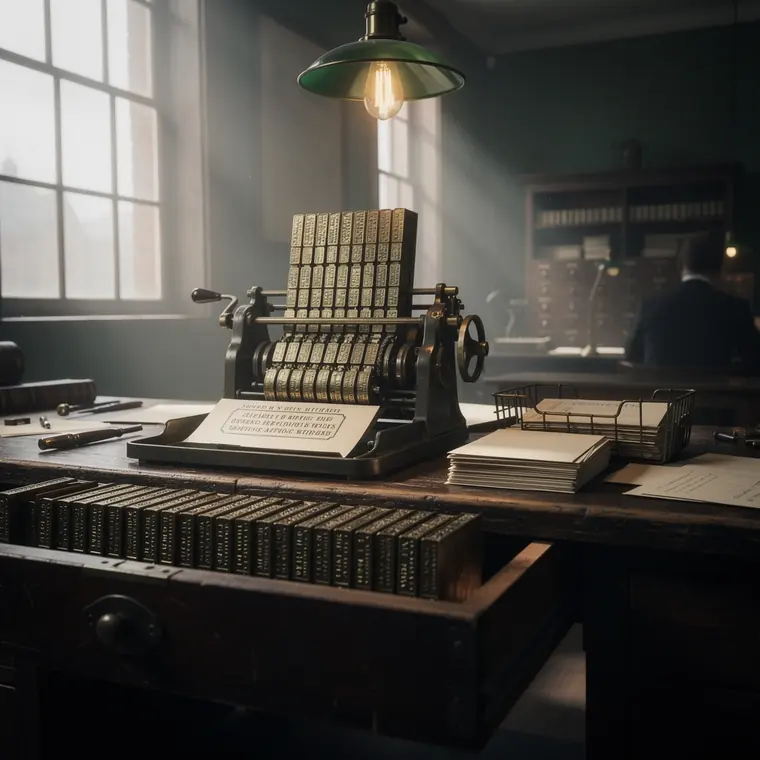
A machine fed from a magazine of small embossed metal plates stacked in a column, each plate carrying raised rows of tiny embossed type, a lever arm at the side, a printed envelope emerging on a tray below with a smudged block of address type, a long wooden drawer of plates standing open on the bench beside it, the plates ranked on edge in the drawer, the bench beneath a tall window on the left, an electric bulb in a green glass shade hanging above, a pile of plain envelopes and a wire tray beside it, flat desks and a card-index cabinet running back into the dim office with dark unlit figures at the far desks.
- What it was used for
- The Addressograph was an addressing machine. Joseph S. Duncan, then of Sioux City, Iowa, filed for it on 2 August 1893; patent 558,936 was granted on 28 April 1896 and assigned to the Addressograph Company of Chicago. The specification describes an endless type-belt of hinged link-plates suspended over a drum with a step-by-step revolution; at each stroke a platen presses the envelope, the postal card "or other surface" down until the plate beneath meets it through an opening. Duncan preferred to set the type in rubber. One documented user: a Graphotype Addressograph of about 1920 in the London Museum punched details into aluminium strips that then served as masters for printing envelopes, and in its working life stood at the Paddington Chamber of Commerce. The 1924 price list runs from $37.50 for a hand-operated model printing about 1,000 addresses an hour to $1,500 for an automatic-feed electric machine printing 9,600.
- What was new
- The list became an object you could alter - but Duncan takes the chain of detachable type-plates over a drum as given: he describes improvements in such addressing machines. His first claim reads: an endless type-belt of hinged link-plates suspended on a single drum with a step-by-step revolution. The description draws the consequence - when a name becomes obsolete it may be removed from the link and another substituted; if the list shrinks, blank links are taken out; if it grows too long it is divided into several belts, which can be rolled up and hung away in a small space. He made no claim to the type itself: he has not shown it in the drawings, as a similar use of type is an old device. The barb lies in what the plate later stood for. In the Second World War the Addressograph-Multigraph Corporation was the main supplier of the embossing and imprinting machines for US Army identification tags; Graphotype embossing machines were issued without requisition to reception centers and to Machine Record Units, and a Model 70 hand imprinter printed the tag back onto the Medical Department's paperwork. The plate you could lift out of a mailing list had become the man.
What the sources leave open: The often-repeated hexagonal wooden block is unsourced; an account quoted without attribution by the Early Office Museum speaks only of rubber type glued on a block of wood. No patent number for the Graphotype could be found. The Early Office Museum mentions insurance companies only in general as users of addressing machines; no source mentions utilities or any census link. The source dates Circular No. 151 on identification tags both 3 and 12 December 1940, so it is omitted.
Further reading
- US-Patent 558.936, Joseph S. Duncan, Addressing-Machine (angemeldet 1893, erteilt 1896)
- Early Office Museum, Antique Mail Machines (Addressograph, Graphotype, Preise 1924)
- London Museum, Addressograph machine, Acc. 78.54 (Paddington Chamber of Commerce)
- WW2 US Medical Research Centre, U.S. Army WW2 Dog Tags (Graphotype, Modell 70)
- Encyclopedia of Cleveland History (Case Western Reserve University), AM International Inc.