The Gestetner Cyclostyle
1894 · Rotary Duplicator · Work 541 of 1,871
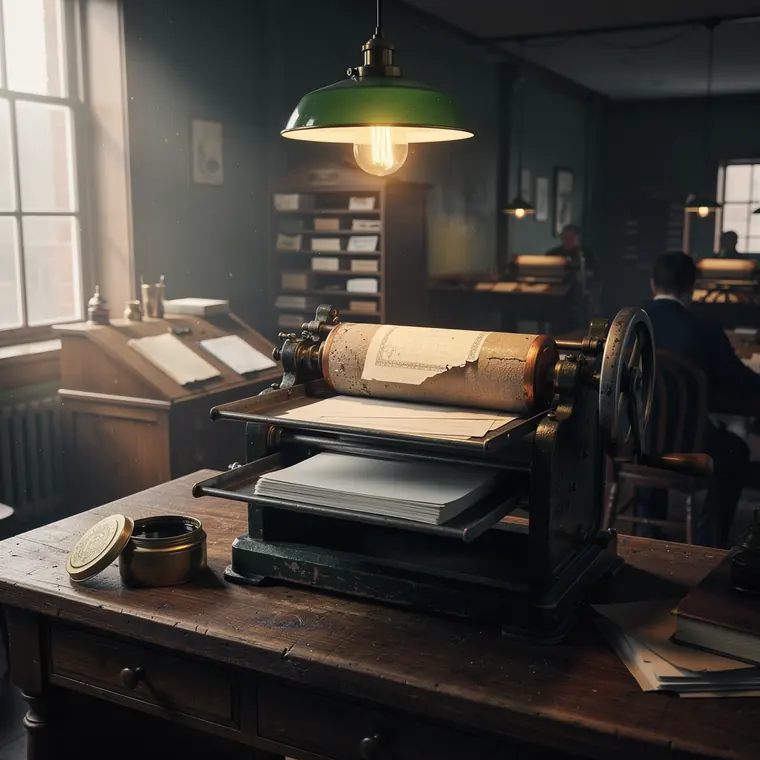
A rotary duplicator with a cylindrical ink drum, a hand crank on the right, a feed tray of blank paper above and a delivery tray of printed sheets below, the stencil on the drum worn through at one corner, the frame cast iron on a wooden base, an ink tin with its lid off, the machine on a bench beside a tall window on the left, an electric bulb in a green glass shade hanging above, a slant-top desk and a pigeonhole cabinet behind, the office running into shadow with dark unlit figures at the far desks.
- What it was used for
- David Gestetner, born at Csorna in Hungary in 1854 and died in 1939, built an office duplicator in London. The core of it is the Cyclostyle pen: a stylus with a small toothed wheel, drawn over a thin paper coated on one side with paraffin wax and stretched over a smooth metal plate. The wheel cuts a line of minute perforations - a stencil, through which ink is then forced. The Science Museum Group dates the apparatus to 1880 and the patent to 1881. Luis Nadeau records that the process was made available in America in 1884 and was also used for duplicating music. For the Automatic Cyclostyle, an 1894 annual report of the Royal Cornwall Polytechnic Society gives the performance that was claimed: one inking of the middle roller sufficient for 100 to 200 copies, and 2,000 copies to be made from a stencil.
- What was new
- The Early Office Museum names the difference from Edison's electric pen in one sentence: the wheel pen needed no battery and produced better stencils. Gestetner was not first in this. Eugenio de Zuccato's Trypograph, on Nadeau's account on the market from the early 1880s, achieved the same thing another way - the paper was stretched over a plate with a multitude of sharp corrugations and pierced from below. In 1893 Gestetner and Albert Blake Dick entered into reciprocal business agreements concerning the manufacture and sale of stencil duplicating equipment in Great Britain and America. Gestetner overtook his own invention: in 1888 the Neo-Cyclostyle replaced the 1881 pen that had made his name. The Rotary Cyclostyle No. 6 of 1902 carries, as the Science Museum Group transcribes the label, a notice that each sheet of Rotary Cyclostyle paper and each tube of ink must bear his signature, "D. Gestetner". For his typewriter stencils, on Nadeau's account, Gestetner imported Japanese Yoshino tissue, replaced in the 1930s by a machine-made paper.
What the sources leave open: No patent and no company record was found for 1894. The Early Office Museum gives 1894 as the year Gestetner introduced the first "automatic" stencil duplicating press; Nadeau dates the patent behind it to 1891, and the Science Museum Group catalogues an example as "c. 1893". So 1894 is a market-introduction year asserted by one source, not a patent year. No Gestetner quotation from an original publication could be found.
Further reading
- Science Museum Group, Cyclostyle apparatus, Objekt 1923-530 (Patent 1881)
- Science Museum Group, Gestetner's Rotary Cyclostyle No. 6 duplicator, Objekt 1963-260 (1902)
- Luis Nadeau, Office Copying and Printing Processes (Kap. 16), Atelier Luis Nadeau 2002
- Early Office Museum, Antique Copying Machines (Cyclostyle 1881, Automatic Cyclostyle, Angaben von 1894)
- English Heritage, Blue Plaques: David Gestetner (1854-1939)
- Science Museum Group, Automatic cyclostyle duplicating machine, c. 1893