The Ditto Spirit Duplicator
1923 · Spirit Duplication · Work 542 of 1,871
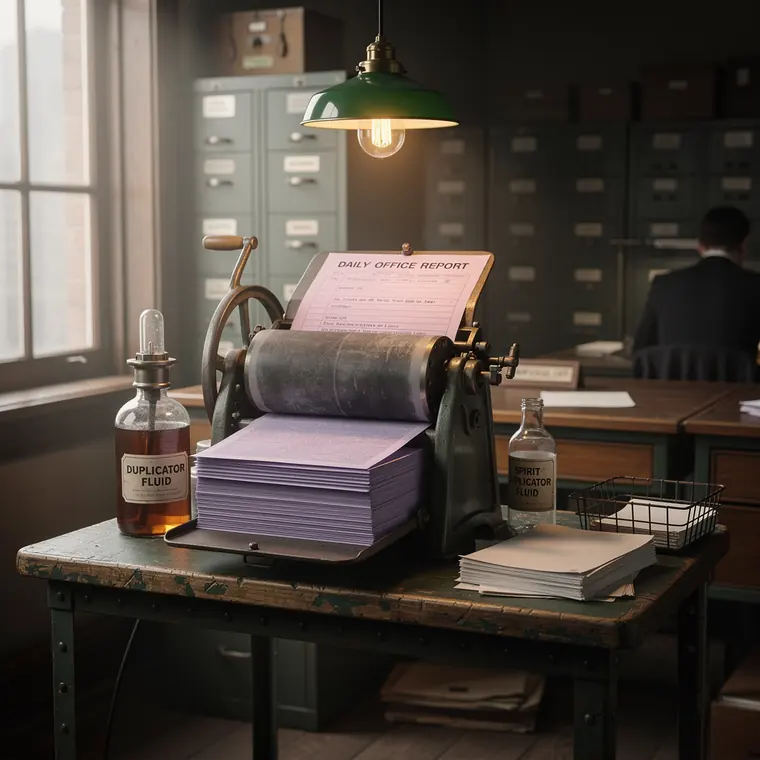
A small duplicator with a fluid reservoir at one end, a hand crank, sheets emerging faintly printed in aniline purple, a used master sheet peeled back and hanging over the edge of the machine, the print pale and fading on the top copy of the stack, a bottle of spirit beside it, the machine on a steel-framed table beneath a tall window on the left, an electric bulb in a green glass shade hanging above, a wire tray and plain papers beside it, steel filing cabinets and flat desks running back into the dim office with dark unlit figures at the far desks.
- What it was used for
- The spirit duplicator copied with dye and solvent instead of printing ink. Wilhelm Ritzerfeld of Berlin-Charlottenburg describes the process in his specification: the original is typed with a sheet coated in copying ink placed behind it, so that a negative record appears on its back; each copy sheet is damped with a rapidly drying liquid and, pressed against the original, dissolves away part of the dye. The inking paper, he writes, permits "say 40 copies or more". The machine was also used in schools: in 1980 the US occupational health institute NIOSH counted 58 spirit duplicators worked by 84 teacher aides in 18 schools in the Everett School District, Washington, and measured 365 to 3,080 ppm of methyl alcohol in the air at machines without local exhaust ventilation. In the GDR, opposition groups ran off leaflets and underground magazines on the Ormig; the memorial museum in the Runde Ecke at Leipzig gives 30 to 250 copies per master.
- What was new
- What was new, on Ritzerfeld's own account, was the mirror-image master. In the processes of this kind then in use, he writes, a positive original served as the master, so the copies had to be taken on thin, absorbent paper; his master carried the image reversed on its back and gave copies on paper of any thickness. In the patent the master made by dye transfer is claimed in claim 1 and the solvent step only in claim 2; the colour purple does not appear in it at all. The barb stands in a later patent of the company itself. In 1938 Ditto, Incorporated describes how it had not hitherto been practical to employ electrically driven machines for the wet process, because sparks might ignite the alcohol; the process had therefore been limited to hand-driven equipment, which naturally retarded its expansion. The office machine of the electrical age had to be cranked by hand because its own working fluid burned. The way out the patent proposes is to dose the alcohol with 3 to 35 per cent of a chlorofluorocarbon.
What the sources leave open: 1923 is verifiable in two sources as the year the process was introduced (Early Office Museum, Luis Nadeau), not as a founding, trademark, machine or patent of Ditto, Incorporated - and it falls a year before Ritzerfeld's own German priority date of 2 April 1924. No German patent of 1923 was found. The common figure of "20 to 50 copies" could not be traced to any reliable source.
Further reading
- US-Patent 1.645.930, Wilhelm Ritzerfeld, Process for Multiplying Records (deutsche Priorität 2.4.1924, erteilt 1927)
- US-Patent 2.254.469, Johan Bjorksten für Ditto, Incorporated, Nonflammable Solvent (1938/1941)
- MMWR 1980;29(36):437-438, NIOSH: Methyl Alcohol Toxicity in Teacher Aides Using Spirit Duplicators
- Gedenkstätte Museum in der Runden Ecke, Leipzig: Spiritus-Umdruck-Verfahren oder Ormig-Vervielfältigung (Glossar)
- Luis Nadeau, Office Copying and Printing Processes (Eintrag 1.56, Spirit Duplicating 1923)
- Early Office Museum: Copying Machines