The Pigeonhole Desk
1870 · Pigeonhole Storage · Work 543 of 1,871
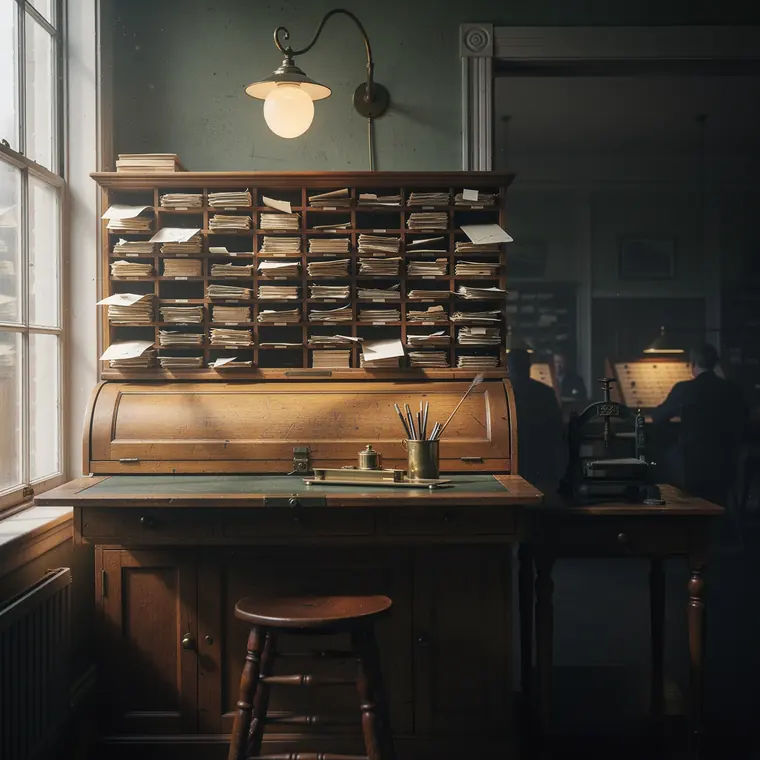
A tall wooden desk whose upper structure is a honeycomb of small pigeonhole compartments, letters folded lengthwise and stood on edge in each, most compartments crammed full, a few letters leaning out, the roll top pushed back into its housing, a brass inkwell and a pen tray on the writing surface, a high stool before it, the desk beside a tall window on the left, a gas bracket with a frosted globe on the wall, a copying press on a side table and a slant-top desk behind, the counting room fading into shadow with dark unlit figures at the far desks.
- What it was used for
- Before filing cabinets, the desk was the file. The "Cabinet Office Secretary" of the Wooton Desk Company, Indianapolis, held books and papers in compartments standing all round the man seated at it. In December 1874 the firm advertised it in the Indianapolis Journal as the most complete desk for filing documents ever made, well adapted to the use of county officers. According to the Smithsonian monograph it was used by lawyers, bankers, railroad men, newspaper editors and educators as well as county officials; in 1881 one was purchased for the Kansas State Superintendent of Public Instruction's Capitol office. Spencer Baird, Secretary of the Smithsonian Institution from 1878 to 1887, owned a Standard Grade and wrote the company long letters because he wanted an Ordinary grade desk made that would hold a 13-inch sheet of foolscap; the firm declined, saying it was too hurried in getting out its desks to undertake changes in interior arrangement. In January 1876 his order went through after all.
- What was new
- What was claimed was not the pigeonhole but the carcase. Patent 155,604, "Improvement in Secretaries", issued on 6 October 1874 to William S. Wooton, describes a secretary composed of three parts: the two narrower are hinged to the wide one and serve as doors, and each of the three carries compartments or pigeonholes for books and papers. Everything thus lay within reach at once and behind one lock. A London dealer, Richards, Terry and Company, advertised in The Graphic on 17 May 1884 with one hundred and ten compartments, all under one lock and key. Wooton was not alone: the Smithsonian monograph by Betty Lawson Walters names the Moore Combination Desk Company and a cabinet-desk patent by Coffin of 23 March 1886, and roll-top desks stood alongside, not after. The same monograph gives the barb: by the 1890s, with typewriters and duplicating machines producing more records, business seemed to have outgrown the Wooton desk and reverted to smaller desks with auxiliary filing cabinets. In 1914 J. William Schulze writes of the roll-top desk, fast disappearing from well-run offices, that it becomes a receptacle for important papers which are forgotten, and that most papers in its pigeonholes belong in the files, where they are accessible to everyone who needs them.
What the sources leave open: The famous owners come largely from the company's own catalogues. On Grant's desk the Smithsonian monograph notes in a footnote that no documentation for it has been found among the Grant papers; Queen Victoria is put in parentheses as "(perhaps)" by the Kansas Historical Society itself, and the monograph does not mention her. No source gives a compartment count for any particular grade; the 110 stands in a dealer's advertisement.