The Vertical File
1898 · Vertical Filing · Work 545 of 1,871
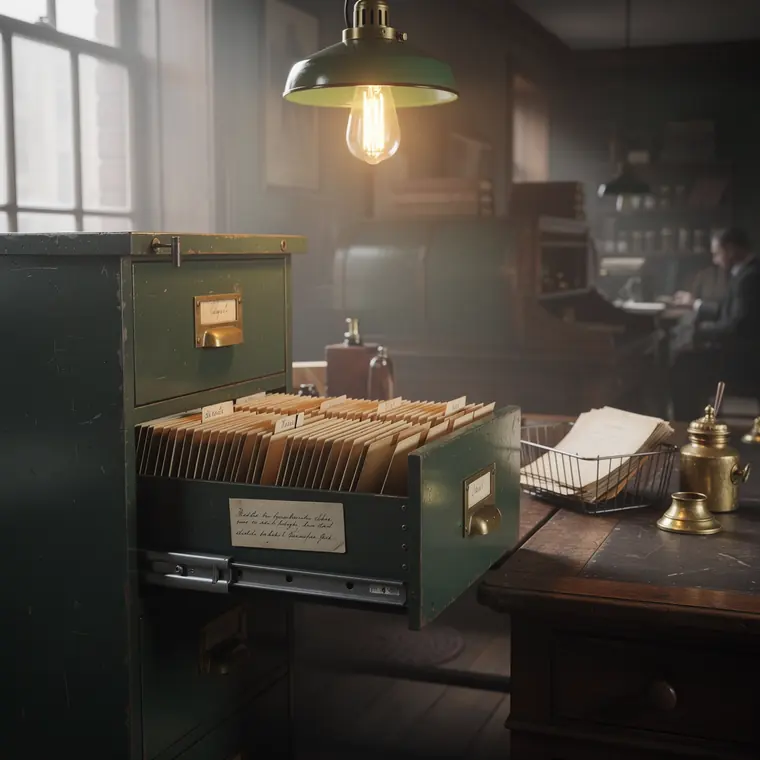
A bank of steel drawers, one pulled fully out on its slides to show papers standing on edge in folders with plain tabs, a following block pressed up behind them, a plain card in the drawer's brass label holder, the cabinet's face dark green with brass pulls, the cabinet beside a tall window on the left, an electric bulb in a green glass shade hanging above, a flat desk with a wire tray and a brass inkwell beside it, more cabinets and roll-top desks running back into the dim office with dark unlit figures at the far desks.
- What it was used for
- Vertical filing set the letter on its edge. Instead of being folded into a pigeonhole it stood in a folder in a drawer, alphabetically behind guide cards. What the thing was for stands in the title of the manual the Globe-Wernicke Co. of Cincinnati published around 1910: filing and finding papers. The guide card was a finding aid and a brake on error at once, and the manual does the arithmetic: a clerk putting a paper back into one of fifty full folders standing between only two guides is apt to misfile it; with six guides instead of two, fewer mistakes would occur. For a drawer of 20 inches inside depth the firm recommended 40 alphabetical guides, equivalent to a filing capacity of four to five thousand papers such as used in ordinary correspondence. In 1914 J. William Schulze wrote that, except in isolated cases, the vertical file cabinet in wood or metal had become standard equipment.
- What was new
- What was new was that the single sheet became addressable: in the pigeonhole papers sat folded in envelopes that had to be found, opened and unfolded, while in the drawer they stood in folders behind guide cards anyone could read without taking anything out. Who thought of it is not settled. Craig Robertson writes in 2021 that the initial impetus came from a man identified as Dr. Nathaniel Rosenau, secretary of a charity organization in Buffalo, who carried the idea of index cards stored on their edges over to larger papers and in 1892 took it to the Library Bureau's Chicago office, which built a prototype. For 1898 the insurance man Edwin G. Seibels claimed the invention for himself, and the barb is his: Seibels applied for a patent and was refused, on the ground that a system is an idea and only a device can be patented. In doing so, as he himself said, he overlooked that setting the envelopes upright and separating them by guide cards was itself a patentable device. Thirty-nine years later the manufacturer presented him with a bronze plaque: on this idea, it says, is founded an industry that provides employment for many men and women.
What the sources leave open: I could not find the recollection the profile says Seibels wrote in 1927; the sentences attributed to him come from the South Carolina Business Hall of Fame profile (1999, South Carolina ETV Commission). The gold medal at the 1893 world's fair goes back, on Robertson's account, to a 1938 manual by Allen Chaffee and has no archival support. No source adjudicates between Rosenau and Seibels.
Connections
Every connection names its kind. “Forerunner” on its own would be a claim.
- Follows fromThe Card Index1876According to D. Levy (2001), Melvil Dewey adapted the idea of the library card catalogue to produce vertical filing: hanging folders in file cabinets, to which papers and new folders could easily be added. Levy says the new system won a gold prize at the 1893 Chicago World's Fair.Source: Society of American Archivists, Glossary of Archival and Records Terminology: vertical file (citing D. Levy, 2001, pp. 68-69)
Further reading
- Filing and Finding Papers by the Safe Guard Method of Vertical Filing, Globe-Wernicke Co., Cincinnati, um 1910
- Craig Robertson, The Filing Cabinet, Places Journal, Mai 2021
- South Carolina Business Hall of Fame, Edwin G. Seibels (South Carolina ETV Commission, 1999)
- J. William Schulze, The American Office, 2. Aufl. 1914, S. 261 (Filing Equipment)