The Loose-Leaf Ledger
1900 · Post Binder · Work 546 of 1,871
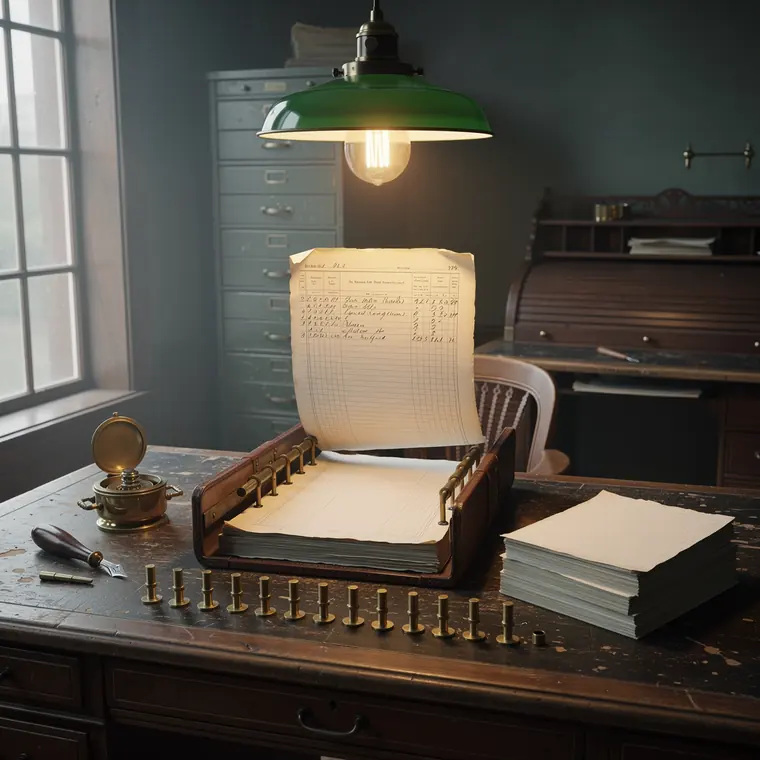
A heavy ledger opened flat with its binding posts unscrewed, one ruled account sheet lifted clear of the stack, a small pile of blank sheets waiting beside it, the binder's brass posts and thumb nuts laid out in order on the desk, the leather covers of the binder worn at the corners, a brass inkwell and a pen beside, the desk beneath a tall window on the left, an electric bulb in a green glass shade hanging above, a vertical file cabinet and a roll-top desk behind, the office reaching into shadow with dark unlit figures at the far desks.
- What it was used for
- The loose-leaf ledger replaced the bound account book with a binder of removable leaves. James H. Rand of North Tonawanda, New York, states the purpose in the first sentence of his specification: ledgers and similar account books, and more particularly bank account books with loose leaves intended to be removed once the accounts on them are closed and transferred to a transfer binder; the removed sheets are replaced by new ones and the cover used as long as it remains serviceable. What it bought is named by Charles A. Sweetland in 1902: the elasticity of the account. No more long pages and short pages, no more double-double to use up space - the loose leaf adjusts itself to the occasion, whether an account contains one item or ten thousand. And: only one man could work at the large bound ledger, which is why statements were always several days late.
- What was new
- What was new was not the binder but the chain of proof that made removal tolerable. Sweetland describes three devices. The slit hole, which lets the leaf spring around the post while the covers are spread, but makes it impossible to extract a leaf without tearing it while the binder is locked. The lock on the cover. And the words "Sheet No." on every page, numbered consecutively, so that an account can be traced from beginning to end by sheet numbers. A six-inch post took about a thousand sheets. Several worked at it at once: James Barker filed for a transfer ledger in 1898 (granted 1899, assigned to The Richmond & Backus Company of Detroit), Ambrose E. Anderson in 1902, Friedrich Bollenbach in 1905. The barb is that the dreaded court fight never came. In May 1907 the legal department of the Journal of Accountancy wrote that there were no decisions of any higher court on the point, and that it was very doubtful the question would ever be raised there. As late as December 1907 the Rhode Island board still set, as a compulsory question, what the objection to loose-leaf depositors' ledgers was; Minnesota wrote loose-leaf and card systems into its law of evidence in 1909.
What the sources leave open: Nothing anchors the loose-leaf ledger specifically to 1900; the nearest dated evidence is Barker's patent of 1898/1899 and Sweetland's 1902 book. Sweetland published his book himself and writes as an advocate. The Journal of Accountancy passages come from microfilm OCR and are given in substance, not quoted verbatim. For Irving-Pitt and Baker-Vawter I found only mentions in the trade press, no founding dates.
Further reading
- US-Patent 790.002, James H. Rand, Account-Book (angemeldet 1901, erteilt 1905)
- Charles A. Sweetland, The Science of Loose Leaf Book-keeping and Accounting, St. Louis 1902
- US-Patent 623.349, James Barker, Transfer-Ledger (The Richmond & Backus Company, 1898/1899)
- The Journal of Accountancy, Mai 1907, Bd. 4 Nr. 1, Legal Department
- The Journal of Accountancy, Januar 1909, Bd. 7 Nr. 3, C.P.A. Question Department (Rhode Island, Auditing, 27.12.1907)
- Minnesota Statutes 600.05, Account books; loose-leaf system (Laws 1909 c. 251 s. 1)