Crystal Palace
1851 · Modular Glass and Iron Structure · Work 55 of 1,871
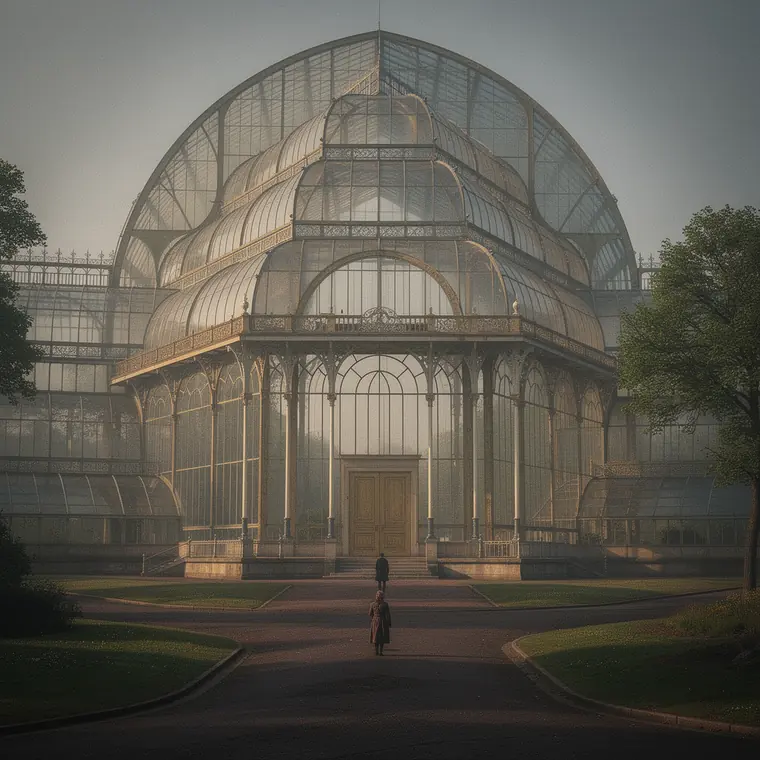
The Crystal Palace in Hyde Park, ridge-and-furrow glazing stepped in tiers, the barrel-vaulted transept arching over full-grown elms left standing inside, cast iron columns repeating down the nave.
- What it was used for
- Exhibition building for the Great Exhibition in Hyde Park, London, opened on 1 May 1851 and running five and a half months. Some 14,000 exhibitors from 34 nations showed more than 100,000 objects; over six million people came. The building covered about 70,000 square metres, ran some 563 m long and took 293,655 panes of glass from Chance Brothers of Birmingham; around 5,000 workmen were employed, with a daily average of 2,000 men and 200 horses on site. From the surplus of 186,000 pounds the commission bought the South Kensington estate on which the V&A, the Science Museum, the Natural History Museum, the Royal Albert Hall and Imperial College now stand. The building was temporary: dismantled in 1852-54 and re-erected larger at Sydenham, it burned down there on 30 November 1936.
- What was new
- Building in iron and glass was not new. Paxton's own conservatories at Chatsworth dated from the 1830s, Turner and Burton had finished the Palm House at Kew in 1847, and in the same year Turner roofed Liverpool Lime Street with a 50 m span. What was new was reducing a very large building to a single module: columns at 24-foot centres and one standard pane, everything prefabricated and dry-assembled - seven hectares of building were watertight in 27 weeks. The building committee had already rejected 245 submitted designs, and its own as well, on which Brunel had worked. Paxton sketched his on blotting paper on 11 June 1850 during a railway board meeting in Derby; the V&A holds an 1851 facsimile of it.
Connections
Every connection names its kind. “Forerunner” on its own would be a claim.
- EncounteredThomas Arithmomètre1851The Great Exhibition opened on 1 May 1851 in Hyde Park and ran for five and a half months, housed in the building known as the Crystal Palace. Thomas's arithmometer was one of two calculating machines there to receive a prize medal; the jury ranked it below Israel Abraham Staffel's machine.Source: Stephen Johnston, Making the arithmometer count, Bulletin of the Scientific Instrument Society 52 (1997), 12-21 · Victoria and Albert Museum: The foundation of the V&A's Collections - the Great Exhibition of 1851
- EncounteredNasmyth Steam Hammer1839Nasmyth's steam hammer was on show at the Great Exhibition, which opened on 1 May 1851 in the Crystal Palace in Hyde Park. A photograph by Claude-Marie Ferrier from 1851 shows it; it illustrates the second volume of the official Reports by the Juries. The machine is inscribed 'J. Nasmyth & Co Engineers, Manchester'.Source: Royal Collection Trust, RCIN 2800024: The Great Exhibition, 1851 - Steam Hammer by Nasmyth (Claude-Marie Ferrier, 1851) · Victoria and Albert Museum: The foundation of the V&A's Collections - the Great Exhibition of 1851
Further reading
- Victoria and Albert Museum: The Great Exhibition of 1851 (Aussteller, Objekte, Besucher, Glasscheiben)
- Royal Commission for the Exhibition of 1851: History Archive (Überschuss, South Kensington)
- Bill Addis: The Crystal Palace and its Place in Structural History, Construction History 2006 (Raster, Bauzeit, 245 Entwürfe, Kew, Lime Street)
- V&A Collections: Facsimile of Paxton's blotting-paper sketch (O186594)
- The National Archives Blog: Remembering the Crystal Palace fire of 1936
- The Royal Parks: The Great Exhibition of 1851 in Hyde Park