Thomas Arithmomètre
1851 · Stepped Drum · Work 408 of 1,871
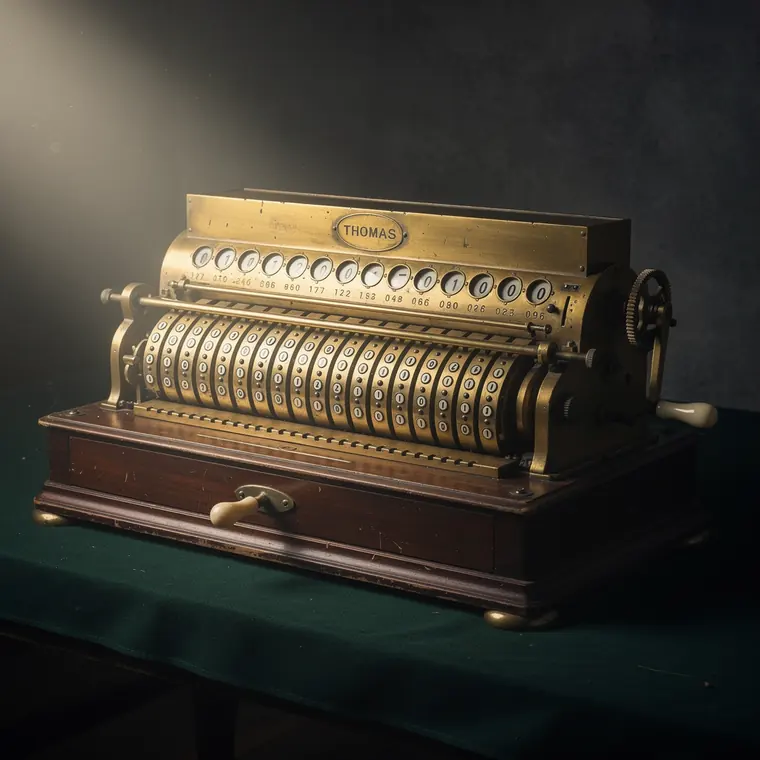
A flat stepped-drum calculating machine in a long mahogany case, the brass top plate carrying a row of sliding setting levers in parallel slots running the length of the plate, a row of small round numeral windows above them, each window showing the single digit 0, an engraved oval maker's plate reading "Thomas", a folding crank at the right end, a small ivory-handled lever for clearing, every other surface plain polished brass and dark mahogany, standing on a dark baize-covered table before a deep neutral background, a single raking light from the left raking along the slots of the setting levers.
- What it was used for
- Charles Xavier Thomas de Colmar built a four-function machine on Leibniz's stepped drum. According to Sebert's report, as quoted by Stephen Johnston, there were "sales of 500 machines up until 1865, 300 for 1865-70, 400 for 1870-75 and finally 300 for 1875-78" — 1,500 in all, so about 33 a year in the first fifteen years. The Arithmeum dates machine number 1203 to 1875, which fits Sebert's series. The buyers were insurance offices, observatories, railways and statistical bureaux; Johnston quotes the Prudential's Henry Harben as saying the company had 24 arithmometers at work on the business and could not have managed without them. In 1866 Henry Brunel, son of Isambard Kingdom Brunel, noted a price of twelve pounds, in Johnston's rendering.
- What was new
- What was new was not the mechanism — the stepped drum is Leibniz's — but the continuity of manufacture. Johnston dates it expressly apart from the patent: "Sustained production of the arithmometer – either individually or in small batches – first began seriously in about 1850", and the 1820 patent represented only a transient prototype. According to the Arithmeum it was the first four-function machine successfully manufactured in series, at first, on Johnston's account, individually or in small batches; the Arithmeum puts the start differently, at "around 1855". And 1851 is no year of success: at the London Great Exhibition the arithmometer was, in Johnston's words, "one of two calculating machines to receive a prize medal, but the jury decided that it was inferior to a Russian entry devised by Israel Abraham Staffel, originally a watchmaker from Warsaw." Thirty years after the patent, the machine came second.
Connections
Every connection names its kind. “Forerunner” on its own would be a claim.
- EncounteredCrystal Palace1851The Crystal Palace housed the Great Exhibition of 1851. There the arithmometer was illustrated in the official catalogue and took one of only two prize medals awarded to calculating machines; the jury nonetheless ranked it below Staffel's Russian entry.Source: Stephen Johnston, Making the arithmometer count (History of Science Museum, University of Oxford) · Victoria and Albert Museum: The foundation of the V&A's Collections - the Great Exhibition of 1851
- EncounteredScheutz Difference Engine1853At the Paris Exposition universelle of 1855 both machines came before the same jury: the Scheutzes' difference engine was awarded the gold medal, the arithmometer no more than an honourable mention.Source: Stephen Johnston, Making the arithmometer count (History of Science Museum, University of Oxford)
Further reading
- Stephen Johnston: Making the arithmometer count (History of Science Museum, University of Oxford; Erstdruck Bulletin of the Scientific Instrument Society 52, 1997)
- Arithmeum, Universität Bonn: Thomas Arithmomètre Nr. 1203, Objekt 1843
- Arithmeum, Universität Bonn: The patent model of Thomas de Colmar's Arithmomètre from the year 1820
- Smithsonian National Museum of American History: Thomas Arithmometer