The Telautograph
1893 · Remote Writing · Work 551 of 1,871
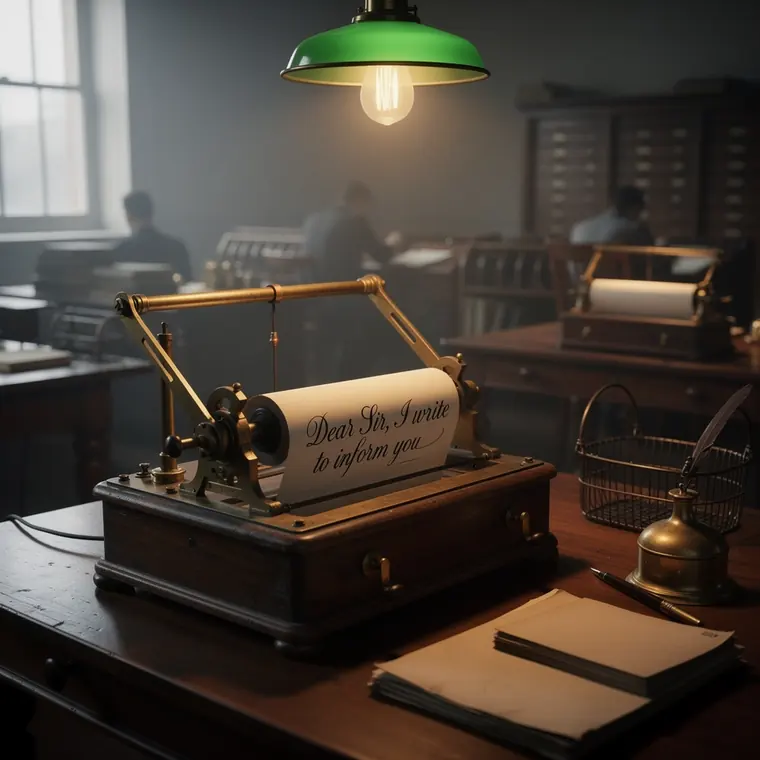
A device with a jointed stylus arm suspended over a paper roll, the arm reproducing a hand's movement transmitted from elsewhere in the building, a half written message on the roll in an unhurried cursive hand, the pen tracing the last stroke, wires leaving at the back of the wooden base, a brass frame and two small pivoted levers, the machine on a flat desk beneath a tall window on the left, an electric bulb in a green glass shade hanging above, a brass inkwell and plain papers beside it, roll-top desks and a card-index cabinet running back into the dim office with dark unlit figures at the far desks.
- What it was used for
- The telautograph was a device that sent handwriting over a telegraph line: at the sending end a stylus guided by levers and pivots, at the receiving end a second stylus retracing the same movement. Elisha Gray began work in 1887 and filed a patent the same year; the Gray National Telautograph Company followed in 1888 and, according to the Engineering and Technology History Wiki, had filed fifteen telautograph patents by 1900. Gray showed the device at the 1893 Chicago World's Fair. It filled niche communication needs: for military fire control in the 1890s, later in banks and hospitals, in steel mills and on manufacturing sites, and in train and bus dispatching — in Grand Central Terminal into the 1960s.
- What was new
- Sending handwriting by wire was not new: Bernhard Meyer's autographic telegraph of 1865 and Edward A. Cowper's, patented in England in 1878, already did it. What was transmitted was not a character from a fixed set but a movement: what arrived at the far end was the sender's own hand, not an impression from a type basket. The Engineering and Technology History Wiki writes that observers in Chicago were impressed because the reproduced handwriting could not be told from the original. Gray was the same man who on 14 February 1876 had filed a telephone application within an hour of Alexander Graham Bell, and had lost the ensuing fight. The barb: his handwriting machine survived in niches where the telephone failed — in steel mills, for instance, too noisy for telephone conversations to be heard. The last US patent on it was filed in 1984; the company passed on in 1971, in 1993 and finally to Xerox in 1999.
What the sources leave open: The main source is the IEEE's Engineering and Technology History Wiki. It gives the date of 14 February 1876 too, but speaks of a caveat from Gray rather than a patent application. That both were filed within an hour comes from Caroline Habluetzel's 2011 McGill dissertation, which also mentions Gray's caveat.