Pneumatic Tube Station
1900 · Pneumatic Despatch · Work 552 of 1,871
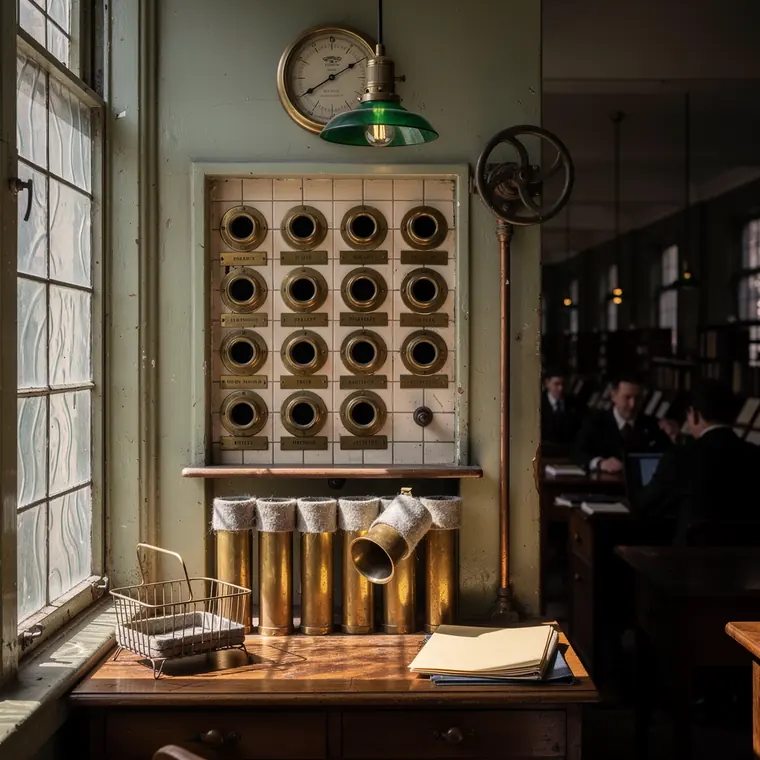
A panel of brass tube mouths set in a tiled recess, each mouth with a small plain brass label plate beneath it, felt-collared carriers racked on a shelf below, one carrier resting half in its tube, a pressure gauge with a round brass rim above the panel, a valve handle at the side, the recess beside a tall window on the left throwing daylight across the brass, an electric bulb in a green glass shade hanging above, a flat desk and a wire tray before the panel, the office reaching into shadow with dark unlit figures at the far desks.
- What it was used for
- A pneumatic tube station was the room in a post office where bundles of letters were packed into steel carriers and shot by compressed air through underground tubes to the next office. An essay by Robert A. Cohen (1999) on the Postal Service's postal-history pages describes the plant: tubes of eight and one-eighth inches in diameter; carriers 24 inches long and 8 inches wide holding five hundred letters; up to five carriers a minute at 30 miles an hour; a double tube could carry 200,000 letters an hour. Philadelphia started on 1 March 1893, New York on 15 October 1897, the line across the Brooklyn Bridge on 1 August 1898; Boston, Chicago and St. Louis followed. New York ended up with 55.5582 miles of tube, worked by 136 staff known as "Rocketeers".
- What was new
- What was new was not the pneumatic tube but that a whole city network hung on it: the letters ran beneath the streets, past the carts and the traffic, and the post offices of a large city lay minutes apart. Yet the Post Office never owned the tubes; it leased them. In 1917 a mile cost 17,000 dollars a year, in 1932 the New York operator offered a mile for 19,500 dollars, and in 1951 a ten-year contract was signed for 1,226,000 dollars. The barb: the service ended on 12 December 1953 because two additional trucks at 25,000 dollars a year were cheaper than a million-dollar lease.
What the sources leave open: All figures come from a single account, Robert A. Cohen's 1999 essay on the Postal Service's postal-history pages. For 1900 it notes only that an appropriations act of 30 June 1899 barred new tube contracts until 30 June 1901; New York began service on 15 October 1897, and the source does not give separate start dates for Boston, Chicago and St. Louis.