The Dictaphone Shaving Machine
1907 · Cylinder Reconditioning · Work 556 of 1,871
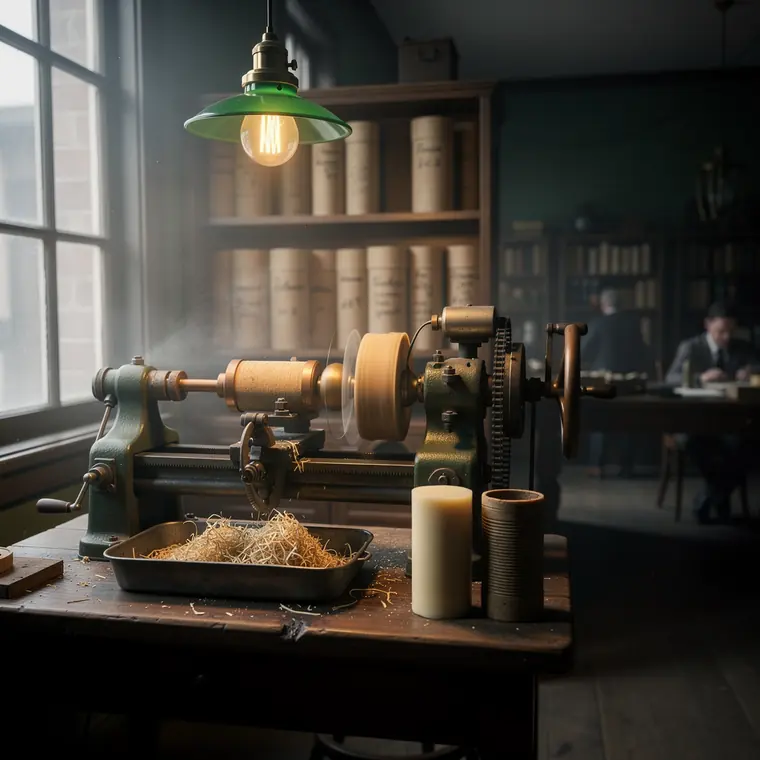
A small lathe-like machine on a bench that pares a used wax cylinder back to a clean surface, a cutting blade held against the turning cylinder, fine wax shavings gathered in a tin tray beneath, a reconditioned cylinder standing beside a used one, the used one dull and scored, the fresh one smooth and pale, a hand wheel and a belt drive at the side, the bench beneath a tall window on the left, an electric bulb in a green glass shade hanging above, a rack of cylinders in cardboard tubes behind, the office reaching into shadow with dark unlit figures at the far desks.
- What it was used for
- The shaving machine was the fourth device of a dictation system: it scraped the recorded surface off a wax cylinder and smoothed it so that the cylinder could be spoken on again. The Computer Museum by System Source describes it as "the shaving machine that scrapes and smooths the dictation from the wax cylinder so it can be reused" and gives the extent of the system: dictating machine, cylinders, transcribing machine, shaving machine. That museum states that a cylinder could be shaved nearly 130 times and that one cylinder held 1,000 to 1,200 words. The name Dictaphone was registered as a trademark by the Columbia Graphophone Company in 1907; the Computer History Museum catalogues a surviving machine with that company as its maker.
- What was new
- What was new was not the wax cylinder but that it became a returnable part: the carrier of the message was not consumed but renewed, and the same piece of wax took, on the museum's figure, some 130 dictations one after another. The barb: the same machine that saved the carrier erased the record. What stayed in the office was the typed letter and its carbon copy; the voice that dictated it was scraped away as soon as the typist had finished.
What the sources leave open: The figures of 130 shavings and 1,000 to 1,200 words come from the Computer Museum by System Source alone; no second confirmation was found. The machine described there is a 1920s Cameo model, patented in 1929, and so later than the 1907 trademark. Which side introduced shaving into office practice first — Edison's or Columbia's — does not follow from the sources; the Library of Congress shows the shaving machine only in the Edison system of the 1910 film.