The Stenotype
1913 · Chord Keyboard · Work 557 of 1,871
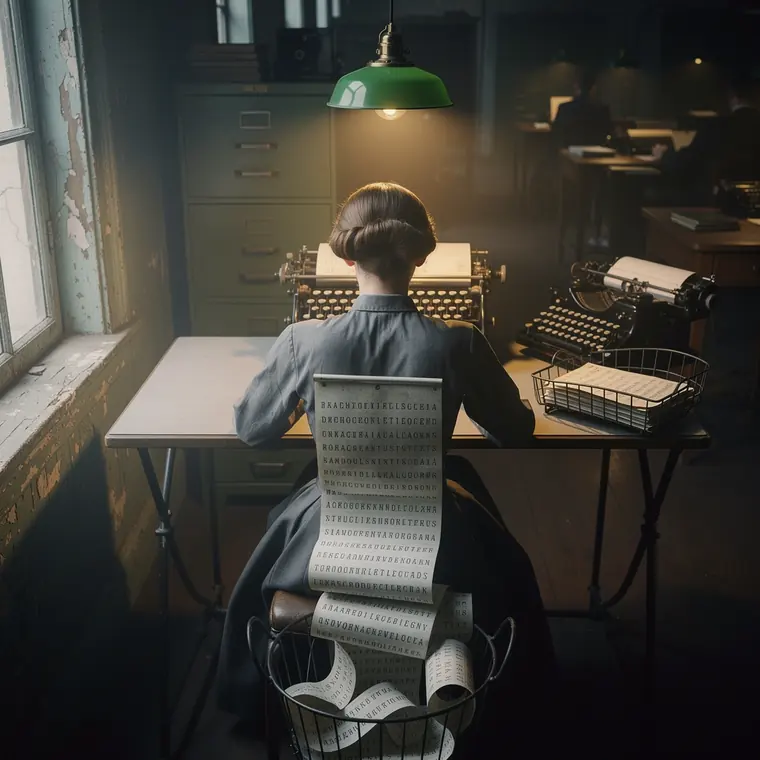
A small machine with twenty-two keys in a low flat bank, the keys plain and rounded, pressed several at a time in chords, a narrow paper tape emerging from the front and folding into a basket below, the tape carrying short groups of capital letters spaced apart, the machine on a slender iron tripod stand, a stenographer seen from behind, hair pinned up, the stand beside a flat desk beneath a tall window on the left, an electric bulb in a green glass shade hanging above, a typewriter and a wire tray on the desk, filing cabinets and desks running back into the dim office with dark unlit figures at the far desks.
- What it was used for
- The stenotype is a typewriter for shorthand: 22 keys, several struck at once, so that whole syllables reach the paper tape in a single stroke. It was invented by Ward Stone Ireland, according to Britannica himself an American stenographer and court reporter; the same source says Stenotype and Stenograph machines are "principally employed for conference and court reporting" and used in offices only to some extent. The Made-in-Chicago Museum describes the device: about 11.5 pounds, the keyboard divided into three fields — initial consonants on the left, final consonants on the right, and four vowel keys. It was made by the Universal Stenotype Company of Owensboro, Kentucky, which, according to a 1913 trade paper quoted by the museum, had grown in less than two years from a workshop into a firm with hundreds of employees, while close to 300 business colleges taught the method.
- What was new
- What was new compared with the typewriter was the simultaneous stroke: not one character after another but one grip for a sequence of sounds, and according to Britannica abbreviations for frequent words let the operator write two or three words in one stroke — so the machine kept pace with speech, which an ordinary typewriter could not. It was not the first shorthand machine: according to the Made-in-Chicago Museum the court reporter Miles Bartholomew had built a 10-key one in the late 1870s. The barb: after First World War munitions contracts the Universal Stenotype Company never restarted and went bankrupt; Ireland, on the museum's account, was reduced to working as a small-time shipping clerk in New Jersey during the Depression and died almost a pauper — and Stenographic Machines, Inc., Milton Wright's new Chicago firm, praised his keyboard in its first handbook of 1940 as having endured without fundamental change.
What the sources leave open: Britannica dates the invention of the Stenotype to "around 1906", the Made-in-Chicago Museum gives the patent of 1911 — two different events, not a conflict. The account of Ireland's last years rests on the museum alone.