The Transcribing Room
1925 · Cylinder Transcription · Work 558 of 1,871
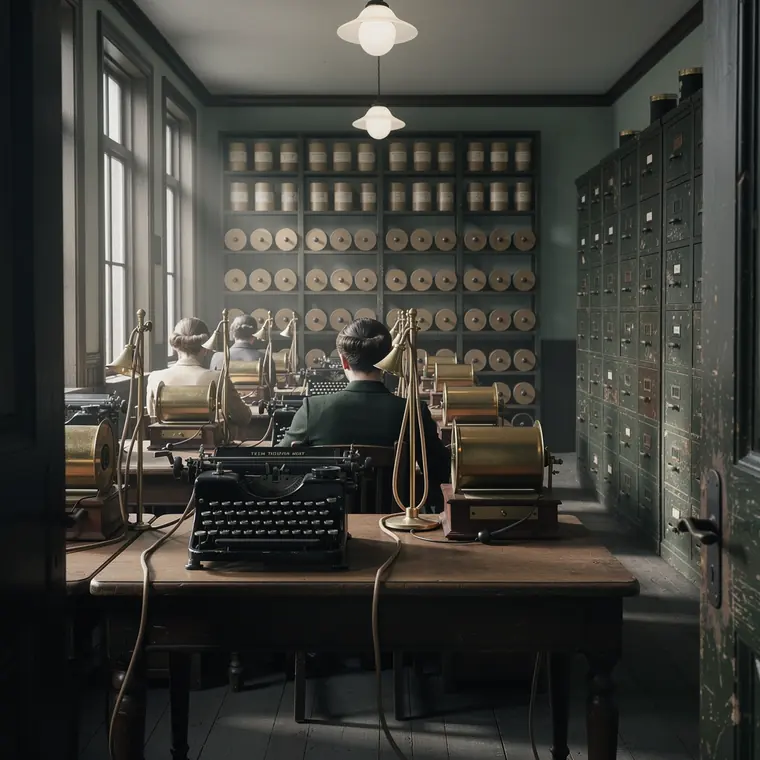
A room of small flat desks, each with a typewriter and a cylinder player beside it, listening tubes hanging over the machines like stethoscopes, each key cap bearing a single capital letter, a rack of cylinders in cardboard tubes with plain round labels on the end wall, typists seen from behind, hair pinned up, dark unlit figures at the far desks, tall windows along the left wall letting in flat grey daylight, electric pendant lamps with white glass shades in a line down the ceiling, steel filing cabinets against the right wall, the desks receding into the depth of the room.
- What it was used for
- The transcribing room was the room where the recorded wax cylinders arrived and became letters: typists listened to the dictation and typed it out. According to the Library of Congress the business phonograph consisted of three machines — one for dictating, one for listening, one for shaving the cylinders — and Edison's promotional film "The Stenographer's Friend" showed them working together in 1910. The Early Office Museum records photographs of offices using these machines: operators at Edison Ediphone transcription machines at Babcock & Wilcox in London in 1939; and, from 1935, an overcharge-claims bureau of an American railroad in which 24 men sit at Dictaphone dictating machines.
- What was new
- What was new was the separation of speaking from writing: dictation and transcript no longer had to happen in the same room at the same time, and the cylinder waited until someone had time for it. A two-person exchange became a process with a buffer in the middle. The barb: the market did not follow. On the figures compiled by IEEE Spectrum, 15,000 dictation machines were sold in the United States in 1923 against 744,000 typewriters, and in 1945 Dictaphone itself reckoned it was serving only 15 to 25 per cent of the available market. The same article, following David Morton, gives one reason: what executives valued in a secretary was precisely what the machine could not do — prompt, correct and fill in.
What the sources leave open: No source could be tied to the year 1925; what is documented is 1910 (the film), 1935 and 1939 (the photographs). The caption of the 1939 London photograph does not state the sex of the operators.