L'Aigle
1869 · Imperial Yacht L'Aigle · Work 560 of 1,871
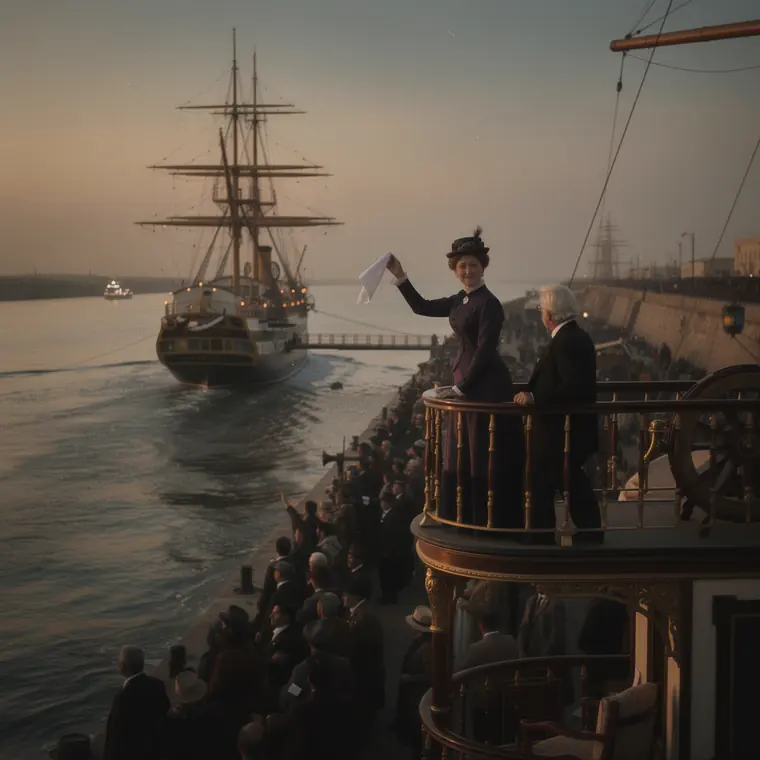
The Suez Canal at Ismailia at dusk, half past five on 17 November 1869, pale orange western sky fading to violet, high sloping banks of yellow sand on both sides, the camera on the east bank astern of the passing imperial yacht L'Aigle, a long dark-hulled paddle steamer with three masts, sails furled, one tall black funnel trailing smoke, a large starboard paddle box amidships, its wheel turning slowly, three paddle boards broken, the paddle boxes almost touching the banks, at the stern the French tricolour, a flag of three equal vertical bands, the band nearest the flagstaff dark blue, the middle band white, the outer band red, on the high poop deck at the stern rail, right of centre, the woman, a woman of forty-three in a small dark hat and a plain dark dress, her right arm raised waving a white handkerchief, face turned toward the bank and the camera, the same height as the man beside her, an elderly white-haired man in a dark frock coat in profile, on the bank below the camera Egyptian lancers on horseback, field guns, a crowd in dark European coats and top hats and in long white galabiyas, far back in the canal the smoke of a second steamer.
- Who
- Eugénie de Montijo (1826–1920) was Empress of the French from 1853 to 1870. Born in Granada, the daughter of a Spanish nobleman, she married Emperor Napoleon III on 30 January 1853; her only son was born in 1856. Three times she acted as regent for her husband, in 1859, 1865 and 1870 – the first time without taking decisions of her own, in 1865 with more weight. She is regarded as France's first "first lady" with a political role of her own. A practising Catholic, she sided with the Pope. She is often credited with a leading part in the decision to set up a French-controlled empire in Mexico, which ended in 1867 when Emperor Maximilian was shot at Querétaro. After the defeat at Sedan she had to flee to England in September 1870. Her son was killed in 1879 fighting the Zulus with the British army. Eugénie died in Madrid on 11 July 1920, at the age of 94.
- The moment
- On 17 November 1869 the Suez Canal was opened. The first ship in the convoy was the imperial yacht L'Aigle with Eugénie on board, and beside her Ferdinand de Lesseps, who had promoted the canal and pushed it through. At eight o'clock she entered the canal at Port Said between two obelisks. The passage was a gamble: the canal was barely 22 metres wide at the bottom, and the paddle steamer measured 19 metres across her paddle boxes. At the El-Guisr ridge the starboard wheel struck the bank and three paddle boards broke. The Empress came to the bridge in tears to congratulate the captain. Towards half past five, at dusk, first a trail of smoke and then a masthead appeared above the high sand banks at Ismailia. Slowly, her wheels barely turning, L'Aigle passed the crowd while the batteries fired a salute. The painter and writer Eugène Fromentin stood on the bank and noted: the Empress on her high poop deck is waving her handkerchief, Monsieur de Lesseps beside her. That is the moment in the picture.
- The other side
- The way had first been dug by people. From 1862 the canal company conscripted thousands of Egyptian peasants for forced labour. At the El-Guisr ridge 20,000 fellahin first carried away four million cubic metres of sand, basket by basket; Couvreux's excavators then removed almost as much again. When the new ruler Ismail abolished forced labour in 1864, the company had to rely more on machines and on recruited foreign workers. Even on opening day the canal was not finished. The captain of L'Aigle reported that on that very day men and dredgers were still at work widening the most difficult passages.
What the sources leave open: No witness describes what the Empress wore that day; the dark dress in the picture is a choice. The time of half past five is given only by Fromentin. Whether she took Lesseps by the hand before the crowd is disputed: an eyewitness book of 1870 says she did, Fromentin writes that she forgot to. The imperial standard at the mainmast is left out of the picture on purpose.
Further reading
Sources
- Herodote.net (Mazarine Vertanessian): Eugénie (1826–1920), impératrice et trois fois régente – Heirat, Sohn, Regentschaften, Flucht 1870, Tod des Sohnes 1879, Tod 1920; Zeittafel mit Maximilian 1867
- Encyclopædia Universalis: Eugénie de Montijo (1826–1920) – Herkunft, ultramontane Katholikin, Rolle beim Mexiko-Unternehmen
- G. Nicole / É. Riou: Voyage des souverains (1870) – Einfahrt 8 Uhr zwischen den Obelisken, Lesseps an Bord, Lesseps bei der Hand, 20.000 Fellachen und Couvreux an der Schwelle El-Guisr, Bagger Borel-Lavalley
- Bericht des Kapitäns J. de Surville an Admiral Rigault de Genouilly, Ismaïlia 18.11.1869 (napoleon.org) – 22 gegen 19 Meter, drei Schaufeln, Kaiserin weinend, Arbeiten am Eröffnungstag
- Eugène Fromentin: Voyage en Égypte 1869, hg. J.-M. Carré, Paris 1935 – Volltext archive.org (17.11.: halb sechs, Räder 'tournant à peine', Taschentuch, Lesseps)
- Lucia Carminati: The toll and toil it took to cleave the Süz Canal through the Egyptian desert, The Conversation, 7.4.2021 – Zwangsarbeit ab 1862, Ende 1864 unter Ismail, danach mehr Maschinen
- Publishers Weekly: Besprechung Karabell, Parting the Desert (Lesseps und Said als Hauptakteure)